
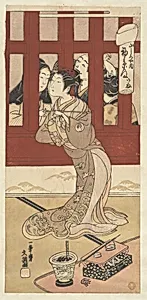
The Actor Bando Hikosaburo II in the Role of the Oiran Hatsuito of Yamashiro-ya
ca. 1770
Medium
Woodblock print; ink and color on paper
Dimensions
12 7/32 x 5 3/4 in. (31.1 x 14.6 cm)
Classification
Prints
Culture & Period
Japan · Edo period (1615–1868)
Department
Asian Art
Museum
Metropolitan Museum of Art, New York, NY
Credit
The Francis Lathrop Collection, Purchase, Frederick C. Hewitt Fund, 1911
Accession Number
JP701
Rights
Public Domain
Tags
Art Historical Context
Step into the dazzling world of Edo-period Japan with Ippitsusai Bunchō's woodblock print, *The Actor Bando Hikosaburo II in the Role of the Oiran Hatsuito of Yamashiro-ya* (ca. 1770). This intimate yakusha-e, or actor portrait, captures the famed kabuki performer Bando Hikosaburo II embodying the glamorous oiran—a high-ranking courtesan from the Yamashiro-ya pleasure house. Bunchō, a master of the ukiyo-e "floating world" style, skillfully renders the actor's poised elegance, elaborate kimono, and hairpin-adorned hair, blurring the lines between stage and reality. Produced during Japan's Edo period (1615–1868), when kabuki theater thrived as popular entertainment, the print highlights the onnagata tradition: male actors specializing in female roles, celebrated for their artistry and allure. Oiran like Hatsuito symbolized beauty and luxury in the Yoshiwara district, making such images coveted souvenirs for theatergoers. Crafted as a woodblock print with ink and color on paper (31.1 x 14.6 cm), it showcases early multi-color techniques—vibrant hues layered by skilled printers—affording affordable access to high culture. Now in the Metropolitan Museum of Art's Asian Art collection, this piece from The Francis Lathrop Collection invites us to appreciate the era's fusion of performance, printmaking, and fleeting pleasures.
About the Artist
Ippitsusai Bunchō · 1730–1820
Ippitsusai Bunchō (active c. 1765–1792) stands as one of the pivotal figures in the development of ukiyo-e actor portraiture, a artist whose innovations fundamentally transformed how kabuki actors were depicted in Japanese woodblock prints. Working during what scholars often call the 'golden age of ukiyo-e,' Bunchō, along with his contemporary Katsukawa Shunshō, revolutionized the yakusha-e (actor...