
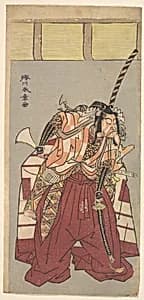
The Actor Ichikawa Danjuro V, Attired in Voluminous Ceremonial Trousers (Nagabakama)
1726–1792
Medium
Woodblock print (nishiki-e); ink and color on paper
Dimensions
12 3/4 x 6 in. (32.4 x 15.2 cm)
Classification
Prints
Culture & Period
Japan · Edo period (1615–1868)
Department
Asian Art
Museum
Metropolitan Museum of Art, New York, NY
Credit
Henry L. Phillips Collection, Bequest of Henry L. Phillips, 1939
Accession Number
JP2893
Rights
Public Domain
Tags
Art Historical Context
In the vibrant world of Edo-period Japan (1615–1868), Katsukawa Shunsh (1726–1792) captured the theatrical flair of kabuki with this striking woodblock print, *The Actor Ichikawa Danjō V, Attired in Voluminous Ceremonialrousers (Nagabakama)*. Shunshō, a founder of the influential Katsukawa school, excelled in yakusha-e—portraits of actors—that brought the drama of the stage to everyday viewers. Here, the legendary kabuki star Ichikawa Danjūrō V strikes a dynamic pose, his flowing nagabakama trousers billowing like dramatic waves, evoking the grandeur of classical Japanese theater roles. This nishiki-e, or "brocade picture," showcases the pinnacle of woodblock printing techniques: intricate carving on multiple blocks allowed for vivid layers of ink and color on paper, creating a luxurious, multicolored effect that mimicked fine textiles. Measuring just 12¾ x 6 inches, these affordable prints democratized art, adorning homes across Japan and preserving fleeting performances for posterity. The inclusion of weapons in the tags hints at Danjūrō's portrayal of heroic warriors, a staple of kabuki's aragoto style—bold, exaggerated acting that thrilled audiences. As part of the Metropolitan Museum of Art's Henry L. Phillips Collection, this print offers a window into ukiyo-e's ("pictures of the floating world") celebration of ephemeral pleasures like theater, blending artistry with cultural reverence for performance.
About the Artist
Katsukawa Shunshō 勝川春章 (Japanese) · 1726 –1792
Japanese, 1726–1792