
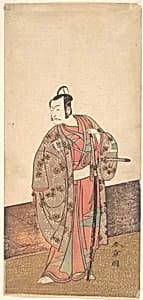
The Actor Ichikawa Danjuro V standing inside of a house and in front of an engawa
ca. 1772
Medium
Woodblock print (nishiki-e); ink and color on paper
Dimensions
12 3/4 x 5 3/4 in. (32.4 x 14.6 cm)
Classification
Prints
Culture & Period
Japan · Edo period (1615–1868)
Department
Asian Art
Museum
Metropolitan Museum of Art, New York, NY
Credit
The Howard Mansfield Collection, Purchase, Rogers Fund, 1936
Accession Number
JP2686
Rights
Public Domain
Tags
Art Historical Context
In this vibrant woodblock print from around 1772, Katsukawa Shunshō captures the kabuki actor Ichikawa Danūrō V poised dramatically inside a traditional Japanese house, just before an engawa (anda). Shunshō, a leading figure in the ukiyo-e ("pictures of the floating world") tradition during Japan's Edo period (1615–1868), specialized in yakusha-e—intimate portraits of theater stars that blurred the line between art and celebrity fandom. Danjūrō V, a superstar known for his powerful aragoto (rough, heroic) roles, stands with a sword at his side, evoking the intensity of kabuki drama. The medium, nishiki-e (brocade print), revolutionized printmaking in the 1760s with its lush, multi-layered colors achieved through precise carving of multiple woodblocks and intricate registration techniques. Measuring just 12¾ x 5¾ inches, this compact format was ideal for affordable dissemination among Edo's urban enthusiasts, turning actors into household icons. This work exemplifies the cultural boom of kabuki in 18th-century Japan, where prints like Shunshō's served as both promotional posters and collectibles, preserving the fleeting glamour of live performance. Housed in the Metropolitan Museum of Art's Asian Art collection, it offers a window into a society captivated by theatrical escapism.
About the Artist
Katsukawa Shunshō 勝川春章 (Japanese) · 1726 –1792
Japanese, 1726–1792