
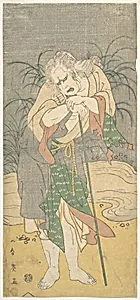
七代目片岡仁左衛門の安達が原のこつがいにん黒塚ばゝア|The Actor Kataoka Nizaemon VII as the Old Beggar Woman Kurozuka Babā at Adachigahara
1795 (Kansei 7), 11th month
Medium
Center sheet of a triptych of woodblock prints (nishiki-e); ink and color on paper
Dimensions
Vertical hosoban; Image: 12 3/8 × 5 9/16 in. (31.4 × 14.1 cm)
Classification
Prints
Culture & Period
Japan · Edo period (1615–1868)
Department
Asian Art
Museum
Metropolitan Museum of Art, New York, NY
Credit
Purchase, Joseph Pulitzer Bequest, 1918
Accession Number
JP334
Rights
Public Domain
Tags
Art Historical Context
This striking woodblock print by Katsukawa Shun'ei captures the renowned kabuki actor Kataoka Nizaemon VII in the dramatic role of Kurozuka Babā, the fearsome old beggar woman from the legend of Adachigahara. Created in 1795 during the Kansei era, the work forms the center sheet of a triptych in the vertical hosoban format, showcasing the actor’s expressive pose and elaborate costume with bold lines and vibrant colors typical of nishiki-e, or “brocade pictures.” Shun'ei, a leading artist of the Katsukawa school, specialized in yakusha-e (actor prints) that brought the excitement of Edo’s kabuki theater to a wider audience. These affordable prints allowed theatergoers to relive favorite performances and served as both souvenirs and works of art. The role depicted draws from a chilling Noh and kabuki tale of a demoness disguised as an elderly woman, highlighting the actor’s skill in onnagata (female impersonation), a hallmark of traditional Japanese stagecraft. As a product of Japan’s Edo period, this print reflects the vibrant urban culture where theater, fashion, and popular imagery intertwined. Its preservation in the Metropolitan Museum of Art offers today’s visitors a vivid glimpse into the artistry and storytelling traditions that captivated audiences over two centuries ago.
About the Artist
Katsukawa Shun'ei 勝川春英 (Japanese) · 1762 –1819
Japanese, 1762–1819