
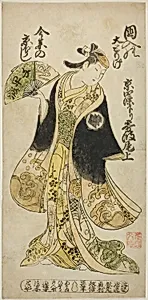
The Actor Kirinami Onoe as Osasa in the play "Hachijin Taiheiki," performed at the Nakamura Theater in the eighth month, 1727
1727
Medium
Hand-colored woodblock print; hosoban, urushi-e
Dimensions
32.6 × 15.7 cm (12 7/8 × 6 3/16 in.)
Classification
woodblock print
Department
Arts of Asia
Museum
Art Institute of Chicago
Accession Number
34083
Rights
Public Domain
Art Historical Context
In the bustling world of Edo-period Japan1603–1868), theater was a cultural phenomenon, and Okumura Masanobu's 1727 woodblock captures this vibrancy. Titled *The Actor Kirinamie as Osasa in play "Hachijinheiki," performed at Nakamura Theater in the eighth*, it depicts the kabuki star in a dramatic pose, embodying the heroine Osasa. Masanobu (1686–1764), an innovative ukiyo-e ("pictures of the floating world") artist, specialized in yakusha-e—actor portraits that immortalized stage icons and their elaborate costumes, makeup, and gestures for fans. This hosoban (narrow-format) print, measuring just 32.6 × 15.7 cm, exemplifies Masanobu's pioneering urushi-e technique. Hand-colored and coated with lacquer (urushi), it gleams with a luxurious sheen, mimicking Western oil paintings and elevating affordable woodblocks to high art. Produced during a boom in commercial printmaking, such works made kabuki accessible beyond the theater, fueling a craze for celebrity culture. Housed in the Art Institute of Chicago's Arts of Asia department, this print highlights ukiyo-e's role in democratizing art and preserving Japan's theatrical heritage, offering a window into 18th-century urban life.
About the Artist
Okumura Masanobu · 1686–1764
Japanese, 1686–1764