
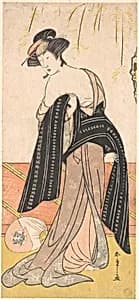
The Actor Nakamura Riko as an Oiran Tying Her Obi
ca. 1779
Medium
Woodblock print (nishiki-e); ink and color on paper
Dimensions
12 7/32 x 5 5/8 in. (31.1 x 14.3 cm)
Classification
Prints
Culture & Period
Japan · Edo period (1615–1868)
Department
Asian Art
Museum
Metropolitan Museum of Art, New York, NY
Credit
The Francis Lathrop Collection, Purchase, Frederick C. Hewitt Fund, 1911
Accession Number
JP711
Rights
Public Domain
Tags
Art Historical Context
Step into the dazzling world of Edo-period Japan with Katsukawa Shunshō'sThe Actor Nakamura Riko as aniran Tying Her Obi (ca. 1779). This woodblock print kabuki star Nakamura Riko in the role of an oiran—a high-ranking courtesan—midway through the intricate ritual of tying her obi. Shunshō, a master of the ukiyo-e ("pictures of the floating world") tradition, specialized in yakusha-e, or actor portraits, that brought the theater's energy to everyday viewers during Japan's vibrant 18th century. Crafted as a nishiki-e, or "brocade picture," this ink and color print on paper showcases the revolutionary multi-block printing technique perfected in the 1760s. Vibrant hues and fine details mimic luxurious textiles, making affordable art accessible to urban commoners. At just 12 7/32 x 5 5/8 inches, it was designed for intimate appreciation, perhaps tucked into a sleeve or album. This Met Museum gem highlights kabuki's onnagata tradition—male actors embodying female grace—and the cultural allure of oiran fashion. Shunshō's dynamic pose and expressive face immortalize a fleeting theatrical moment, offering a window into Edo Japan's playful fusion of performance, beauty, and print innovation.
About the Artist
Katsukawa Shunshō 勝川春章 (Japanese) · 1726 –1792
Japanese, 1726–1792