
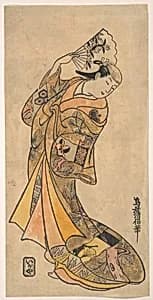
The Actor, Nakamura Shichisaburo II, 1703–1774 as a Woman with Fan
Medium
Woodblock print; ink and color on paper
Dimensions
H. 12 in. (30.5 cm); W. 5 3/4 in. (14.6 cm)
Classification
Prints
Culture & Period
Japan · Edo period (1615–1868)
Department
Asian Art
Museum
Metropolitan Museum of Art, New York, NY
Credit
H. O. Havemeyer Collection, Bequest of Mrs. H. O. Havemeyer, 1929
Accession Number
JP1600
Rights
Public Domain
Tags
Art Historical Context
Step into the vibrant world of Edo-period Japan with *The Actor, Nakamura Shichaburo II (1703–1774) as a Woman with Fan a captivating woodblock print by Tor Kiyomasu II. intimate work, measuring just 12 inches tall and 5¾ inches wide, captures the kabuki performer in an elegant female role, gracefully wielding a fan. Produced during the Edo period (1615–1868), it exemplifies the Torii school's mastery of *yakusha-e*—actor prints that brought the theater's drama to everyday viewers. In kabuki, male actors like Nakamura specialized as *onnagata*, portraying women with astonishing realism through stylized poses, makeup, and costumes. The fan here isn't mere prop; it symbolizes poise and allure, a nod to the "floating world" (*ukiyo*) of entertainment that ukiyo-e prints celebrated. Torii Kiyomasu II's bold lines, vibrant inks, and layered colors on paper made these affordable prints hugely popular, democratizing art for urban audiences in 18th-century Tokyo. Housed in the Metropolitan Museum of Art's Asian Art collection (H. O. Havemeyer Collection, 1929), this piece highlights kabuki's cultural dominance and the Torii dynasty's influence on Japanese printmaking. Imagine the excitement of fans clutching such images— a frozen moment of theatrical magic!
About the Artist
Torii Kiyomasu II · 1706–1763
At one point this artist was incorrectly identified as Kiyonobu II.