
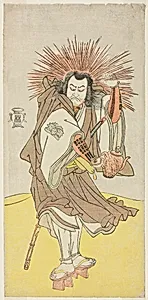
The Actor Nakayama Kojuro VI as Osada no Taro Kagemune (in Reality Hatcho Tsubute no Kiheiji), in the Guise of a Lamplighter of Gion Shrine, in Act Three from Part One of the Play Yukimotsu Take Furisode Genji (Snow-Covered Bamboo: Genji in Long Sleeves), Performed at the Nakamura Theater from the First Day of the Eleventh Month, 1785
c. 1785
Medium
Color woodblock print; hosoban
Dimensions
31.6 × 15.2 cm (12 7/16 × 6 in.)
Classification
woodblock print
Department
Arts of Asia
Museum
Art Institute of Chicago
Accession Number
12727
Rights
Public Domain
Art Historical Context
This vibrant woodblock print by Katsukawa Shunsho captures the kabuki actor Nakayama Koj VI in a dramatic role from the 1785 production of *Yukimotsu Take Furisode Gen* at Tokyo's Nakamura Theater. Titled *The Actor Nakayama Koj VI as Osada noaro Kagemune (in Reality Hatcho Tsub no Kiheiji), in the Guise of aplighter of Gion, in Act Three from Part One*, it showcases the star in elaborate costume as a disguised lamplighter, highlighting the layered identities central to kabuki storytelling. Shunsho (1726–1792), a leading figure in the ukiyo-e ("pictures of the floating world") tradition, mastered yakusha-e—portraits of kabuki performers that brought theater celebrities to the masses during Japan's Edo period (1603–1868). His precise lines and rich colors emphasize the actor's expressive pose and opulent robes, evoking the glamour and intensity of live performances. These prints were affordable souvenirs, fueling kabuki's popularity among urban audiences. Printed in the narrow hosoban format (31.6 × 15.2 cm), this intimate work exemplifies the technical prowess of woodblock printing, where carvers and printers layered colors for vivid depth. Housed in the Art Institute of Chicago's Arts of Asia collection, it offers a window into 18th-century Japan's theater-obsessed culture, where art and entertainment intertwined.