
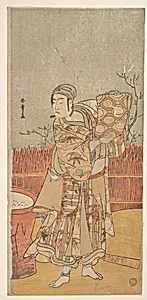
The Actor Sawamura Sojuro III Holding up a Piece of Brocade
Medium
Woodblock print (nishiki-e); ink and color on paper
Dimensions
H. 12 11/16 in. (32.2 cm); W. 5 15/16 in. (15.1 cm)
Classification
Prints
Culture & Period
Japan · Edo period (1615–1868)
Department
Asian Art
Museum
Metropolitan Museum of Art, New York, NY
Credit
Rogers Fund, 1922
Accession Number
JP1353
Rights
Public Domain
Tags
Art Historical Context
In the vibrant world of Edo-period Japan (1615–1868), Katsukawa Shunshō's *The Actor Sawamurajuro III Holding up a Piece Brocade* captures the flair of kabuki stars. Shunshō, a master of the ukiyo-e ("pictures of the floating world") tradition and founder of the influential Katsukawa school, specialized in yakusha-e—striking portraits of actors in dynamic poses. Here, the renowned performer Sawamura Sōjūrō III dramatically holds aloft a shimmering brocade fabric, evoking the opulent costumes and expressive gestures central to kabuki drama. This nishiki-e woodblock print, meaning "brocade picture" for its rich, multicolored layers of ink on paper, exemplifies the technical brilliance of Japanese printmaking. Artisans meticulously carved woodblocks for each color, allowing mass production of affordable art that brought theater culture to everyday viewers. At 12 11/16 x 5 15/16 inches, its intimate chūban format made it ideal for personal collections, reflecting ukiyo-e's democratic appeal. Housed in the Metropolitan Museum of Art's Asian Art Department (Rogers Fund, 1922), this print highlights kabuki's role in Edo society's entertainment boom, blending artistry with celebrity culture. Shunshō's precise lines and vivid hues immortalize a fleeting stage moment, inviting us to appreciate the enduring drama of performance.
About the Artist
Katsukawa Shunshō 勝川春章 (Japanese) · 1726 –1792
Japanese, 1726–1792