
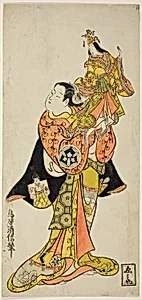
The Actor Yamashita Kinsaku holding a puppet of the Empress in the play "Diary Kept on a Journey by Sea to Izu (Funadama Izu Nikki)," performed at the Nakamura Theater in the first month, 1725
Medium
Hand-colored woodblock print; hosoban, urushi-e
Dimensions
32.7 × 15.3 cm (13 × 6 in.)
Classification
woodblock print
Department
Arts of Asia
Museum
Art Institute of Chicago
Accession Number
19247
Rights
Public Domain
Art Historical Context
Step into the vibrant world of 18th-century Japanese kabuki theater with this exquisite woodblock print by Torii Kiyonobu, a master of the Torii school for its dynamic yakusha-e (actor prints). Created in 1725, the work depicts the actor Yamashita Kinsaku II holding a puppet of the Empress from the play *Diary Kept a Journey by Sea tozu (Funadama Izu)*, performed at Edo's famed Nakamura Theater in the first lunar month. At just 32.7 × 15.3 cm, its narrow hosoban format—ideal for single-sheet portraits—captures Kinsaku's expressive pose and elaborate costume, freezing a fleeting moment of dramatic intensity for everyday admirers. This hand-colored urushi-e print showcases early ukiyo-e innovation, where lacquer-like glue enhanced colors with a glossy sheen before multi-block color printing matured. The Torii school's bold lines and vivid hues celebrated kabuki stars as cultural icons, reflecting the "floating world" of Edo's entertainment districts during the Genroku era's cultural boom. Produced amid strict censorship, such prints democratized theater access, turning actors into folk heroes. Housed in the Art Institute of Chicago's Arts of Asia collection, this gem highlights woodblock printing's role in preserving Japan's theatrical heritage, inviting us to imagine the roar of the crowd and the puppet's imperial gaze.
About the Artist
Torii Kiyonobu II · 1702–1752
Japanese, ca. 1702–1752