
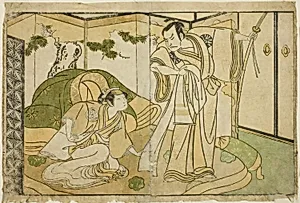
The Actors Nakamura Nakazo I as Taira no Kiyomori (right), and Yamashita Kinsaku II as Tokiwa Gozen (left), in the Play Nue no Mori Ichiyo no Mato, Performed at the Nakamura Theater in the Eleventh Month, 1770
c. 1772
Medium
Color woodblock print; from the illustrated book Yakusha Kuni no Hana (Prominent Actors of Japan)
Dimensions
18.8 × 27.8 cm (7 3/8 × 10 15/16 in.)
Classification
woodblock print
Department
Arts of Asia
Museum
Art Institute of Chicago
Accession Number
88346
Rights
Public Domain
Art Historical Context
Step into the vibrant world of 18th-century Japanese kabuki theater with this exquisite color woodblock print by Katsukawa Shunsho, a master of the ukiyo-e ("pictures of the floating world") tradition. Created around 1772, it captures two star actors from a 1770 performance at the Nakamura Theater: Nakamura Nakazo I as the formidable warrior Taira no Kiyomori on the right, and Yamashita Kinsaku II as the elegant Tokiwa Gozen on the left. Part of the illustrated book *Yakusha Kuni no Hana* (Prominent Actors of Japan), this intimate print (just 18.8 × 27.8 cm) immortalizes a scene from the play *Nue no Mori Ichiyo no Mato*, blending historical drama with theatrical flair. Shunsho's yakusha-e (actor prints) were wildly popular in Edo-period Japan, celebrating kabuki's larger-than-life performers amid a booming urban culture. Taira no Kiyomori, a real 12th-century clan leader, and Tokiwa Gozen, his legendary consort, embody tales of power, romance, and tragedy—staples of kabuki that drew massive crowds to theaters like Nakamura's. Artistically, Shunsho's precise lines, rich colors via nishiki-e technique (multi-block printing for brocade-like hues), and dynamic poses highlight the actors' expressive faces and elaborate costumes. Housed in the Art Institute of Chicago's Arts of Asia collection, this print offers a window into how woodblock art democratized theater stardom, making icons accessible to everyday fans.