
The Adoration of the Einsiedeln Madonna
n.d.
Medium
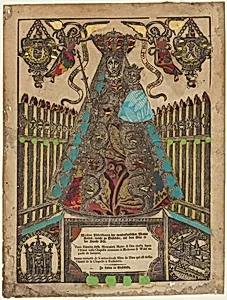
Woodcut in black hand colored with elements of fabric, copper alloy metal foil, and block printed distemper colorants on paper, attached to the verso and visible through cutouts, on ivory laid paper (discolored to buff), laid down on blue wove paper (discolored to tan)
Dimensions
Image: 35.4 × 25.8 cm (13 15/16 × 10 3/16 in.); Sheet: 38.7 × 29.5 cm (15 1/4 × 11 5/8 in.)
Classification
engraving
Department
Prints and Drawings
Museum
Art Institute of Chicago
Accession Number
152176
Rights
Public Domain
About this artwork
Sometime after the production of the 1466 Master E. S. engraving (1972.1), representations of the miraculous Einsiedeln Virgin statue became more iconic and increasingly triangular in appearance. This unique eighteenth-century woodcut was exuberantly adorned at a workshop in stenciled cutouts backed with fabric and metallic scraps, effectively dressed as the statue itself would have been on festive occasions. The text below states in German, Italian, and French that worshippers could visit this ...
Art Historical Context
Behold *The Adoration of theiedeln Madonna*, a devotional woodcut from the collection of the Art Institute of's Prints and Drawings department. This unknown artist's creation honors the revered Black Madonna of Einsied Abbey in Switzerland, a major pilgrimage site since the 9th century where devotees sought her intercession. The image, measuring about 35 x 26 cm, depicts worshippers adoring the sacred figure, embodying the deep Marian devotion central to late medieval and early modern Catholic culture. What makes this print extraordinary are its elaborate mixed-media techniques, blending accessibility with luxury. Crafted as a black-line woodcut on ivory laid paper (now mellowed to buff and laid down on discolored blue wove support), it features hand-coloring, block-printed distemper pigments visible through strategic cutouts, shimmering copper alloy foil for metallic highlights, and even fabric elements attached to the reverse. These enhancements—mimicking illuminated manuscripts or reliquaries—elevated humble prints into tactile, jewel-like objects, affordable yet opulent for pilgrims and laity. This artwork reveals the ingenuity of early printmaking in Northern Europe, where woodcuts democratized religious imagery while incorporating sensory details to inspire faith. Though undated, its sophisticated layering underscores the era's fusion of craft and spirituality, inviting visitors to appreciate how such treasures bridged art and everyday devotion.