
The Adoration of the Magi
possibly ca. 1320
Medium
Tempera on wood, gold ground
Dimensions
17 3/4 x 17 1/4 in. (45.1 x 43.8 cm)
Classification
Paintings
Department
European Paintings
Museum
Metropolitan Museum of Art, New York, NY
Credit
John Stewart Kennedy Fund, 1911
Accession Number
11.126.1
Rights
Public Domain
Tags
About this artwork
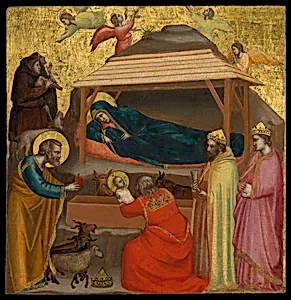
Giotto di Bondone's depiction of the Adoration of the Magi represents a revolutionary moment in Western art history, bridging medieval and Renaissance sensibilities. Created between 1304 and 1306, this work demonstrates Giotto's groundbreaking approach to depicting religious narratives with unprecedented emotional depth and spatial realism. The composition centers on the infant Christ, shown being picked up by one of the kneeling Magi in an impetuous gesture that humanizes the biblical account, ...
Art Historical Context
Giotto di Bondone's *The Adoration of the*, possibly dating to around 1320, marks a pivotal shift in Western art, bridging medieval traditions with the emerging Renaissance. Painted in tempera on wood with a shimmering gold ground—a technique that evoked divine light and continuity with Byzantine icons— this small panel (17 3/4 x 17 1/4 in.) captures the biblical scene with groundbreaking realism. Born in Florence around 7, Giotto revolutionized painting by abandoning flat, stylized Byzantine forms for naturalistic depictions of space, volume, and human emotion, earning praise from contemporaries like Dante. At the heart of the composition is the infant Christ, boldly lifted by a kneeling Magus in a spontaneous, humanizing gesture, while the Virgin Mary gazes with tender concern. Giotto's innovative details shine through: the Star of Bethlehem appears as a vivid comet, likely inspired by Halley's Comet sighted in 1301, blending faith with observed nature. Solid figures and a stable's architectural depth, viewed from below, create a sense of three-dimensionality rarely seen before. This work laid essential groundwork for the Renaissance, influencing generations by infusing sacred narratives with relatable emotion and spatial logic. A gem of the Metropolitan Museum of Art's European Paintings collection, it invites visitors to witness art's evolution firsthand.
About the Artist
Giotto di Bondone
**Giotto di Bondone (c. 1267–1337)** was an Italian painter and architect from Florence whose groundbreaking work marked a pivotal shift in Western art during the Late Middle Ages. Born near Florence, he is widely regarded as the first major figure in the Proto-Renaissance, bridging Gothic traditions with emerging naturalism. Giotto studied under the prominent Florentine painter Cimabue, whose in...