
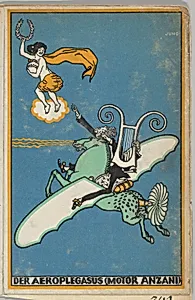
The Aeroplegasus (Anzani Engines) (Der Aeroplegasus (Motor Anzani))
Medium
Color lithograph
Dimensions
Sheet: 5 1/2 × 3 9/16 in. (14 × 9 cm)
Classification
Prints
Department
Drawings and Prints
Museum
Metropolitan Museum of Art, New York, NY
Credit
Museum Accession, transferred from the Library
Accession Number
WW.341
Rights
Public Domain
Tags
Art Historical Context
In 1911, amid the exhilarating dawn of aviation in Europe, Austrian artist Moriz Jung, affiliated with the renowned Wiener Werkstätte, created *The AeroplegasusAnzani Engines)*, a whimsical color lithograph celebrating technological innovation. The Wienerstätte, a hub of the Viennese Secession and Jugendstil movements, blended fine art with functional design, often producing posters that fused fantasy with modernity. This petite print (just 5½ × 3⅜ inches) likely served as an advertisement for Anzani engines—Italian-made powerplants popular in early motorcycles and aircraft—depicting men, women, and a mythical Pegasus reimagined as a flying machine. Jung's masterful color lithography technique allowed for vibrant hues and precise lines, enabling affordable yet artistic reproduction. The hybrid "Aeroplegasus" embodies the era's cultural fervor for flight, merging ancient mythology with cutting-edge engineering in a playful Secessionist style characterized by elegant curves and symbolic motifs. Housed in the Metropolitan Museum of Art's Drawings and Prints department, it captures the pre-World War I optimism when pioneers like the Wright brothers inspired dreams of soaring steeds powered by human ingenuity. This charming work highlights how early 20th-century graphic arts bridged commerce and creativity, inviting viewers to ponder the poetic marriage of myth and machine.
About the Artist
Moriz Jung|Wiener Werkstätte · 1885–1915
Austrian (born Czechoslovakia) Moravia 1885–1915 Manilowa (Carpathians)|