
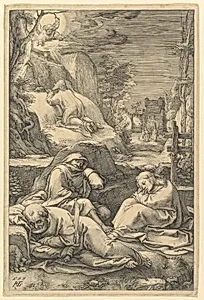
The Agony in the Garden, from "The Passion of Christ"
Medium
Engraving
Dimensions
sheet: 8 1/16 x 5 3/8 in. (20.5 x 13.7 cm)
Classification
Prints
Department
Drawings and Prints
Museum
Metropolitan Museum of Art, New York, NY
Credit
Gift of Henry Walters, 1917
Accession Number
17.37.39
Rights
Public Domain
Tags
Art Historical Context
Hendrick Goltzius, a masterful Dutch engraver of the late 16th century, captures a pivotal moment from the Bible in *The Agony in the Garden* (1597), part of his renowned series *The Passion of Christ*. This engraving depicts Jesus in deep sorrow in the Garden of Gethsemane, praying amid his agony before his arrest, with sleeping apostles nearby and a comforting angel above—evoking profound themes of sadness, divine support, and human frailty, as suggested by the artwork's tags. Goltzius, a leading figure in Northern Mannerism, excelled in engraving, a technique where intricate lines are incised into metal plates to produce richly detailed prints. His dynamic style, with swirling forms and dramatic contrasts, brings emotional intensity to this intimate scene, measuring just 8 1/16 x 5 3/8 inches. Produced during the Counter-Reformation era, such prints were vital for spreading religious devotion, allowing wide dissemination of sacred narratives to the faithful. Today, this gem resides in the Metropolitan Museum of Art's Drawings and Prints department, a gift from Henry Walters in 1917. It exemplifies Goltzius's technical virtuosity and enduring cultural resonance, inviting visitors to reflect on moments of quiet suffering and spiritual resolve.
About the Artist
Hendrick Goltzius · 1558–1617
Hendrick Goltzius (1558–1617) was the most celebrated engraver of the Northern Renaissance and a pivotal figure in Dutch Mannerism. Born near the German-Dutch border, Goltzius transformed printmaking into a virtuoso art form through his revolutionary 'swelling line' technique, where the burin was manipulated to create lines of varying thickness that produced unprecedented tonal effects and three-d...