
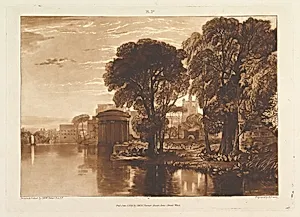
The Alcove, Isleworth (Liber Studiorum, part XIII, plate 63)
Medium
Etching and mezzotint; second state of four (Finberg)
Dimensions
plate: 7 1/4 x 10 3/8 in. (18.4 x 26.4 cm) sheet: 8 1/4 x 11 9/16 in. (21 x 29.4 cm)
Classification
Prints
Department
Drawings and Prints
Museum
Metropolitan Museum of Art, New York, NY
Credit
Harris Brisbane Dick Fund, 1928
Accession Number
28.97.63
Rights
Public Domain
Tags
Art Historical Context
### The Alcove, Isleworth from Turner's *Liber Studiorum* Joseph Mallord William Turner, visionary British Romantic artist renowned for his dramatic landscapes and mastery of light, created * Alcove, Isleworth* as plate 63 in part XIII of his ambitious *Liber Studiorum* series (1807–1819). This etching and mezzotint, printed in 1819, depicts a tranquil riverside scene along the Thames at Isleworth, a picturesque suburb west of London. The "alcove"—likely a shaded garden nook—frames a composition blending architecture, lush foliage, and shimmering water, evoking the pastoral calm of English countryside life. Turner's *Liber Studiorum* ("Book of Studies") was a groundbreaking print series of 71 plates across 14 parts, showcasing his innovative landscape categories like pastoral and architectural. Here, Turner etched the intricate lines himself, while Henry Edward Dawe added rich mezzotint tones for velvety depth and atmospheric glow—a technique perfect for capturing the River Thames's reflective beauty. This second state of four (per cataloguer Alexander Finberg) highlights Turner's push toward painterly prints, rivaling oil paintings in luminosity. Housed in the Metropolitan Museum of Art, this work exemplifies Turner's influence on 19th-century printmaking, bridging fine art and reproduction. Visitors, imagine strolling Isleworth's banks as Turner did, where everyday scenes transcend into poetic splendor. (198 words)
About the Artist
Joseph Mallord William Turner|Henry Edward Dawe|Joseph Mallord William Turner · 1775–1851
Joseph Mallord William Turner, born on 23 April 1775 in London's Covent Garden to barber William Turner and Mary Marshall, emerged as a child prodigy amid personal hardships. His mother suffered mental illness and died in Bethlem Hospital in 1804, while his father supported his early sketches by displaying them in his shop. Around age 10, Turner stayed with his uncle Joseph Mallord William Marshal...