
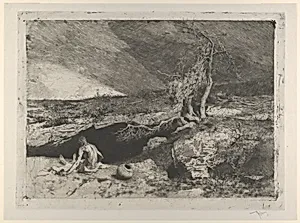
The Anchorite: a partially naked man seated at left in a landscape with what appears to be a long sheet unfolded over his knees
ca. 1869
Medium
Etching and aquatint on Japan paper
Dimensions
Sheet: 15 15/16 × 21 5/8 in. (40.5 × 55 cm) Plate: 14 11/16 × 19 7/8 in. (37.3 × 50.5 cm)
Classification
Prints
Department
Drawings and Prints
Museum
Metropolitan Museum of Art, New York, NY
Credit
Gift of Junius S. Morgan, 1923
Accession Number
23.106.7
Rights
Public Domain
Tags
Art Historical Context
Mariano Fortuny’s *The Anchorite* (ca. 1869) presents a solitary, partially draped male figure seated in a rugged landscape, his form illuminated against the open expanse. An anchorite—a Christian hermit devoted to prayer and seclusion—the subject reflects the nineteenth-century fascination with spiritual isolation and the romantic ideal of nature as a place of contemplation. Fortuny, a celebrated Spanish painter and printmaker, brought his virtuoso draftsmanship to this intimate scene, capturing both the vulnerability of the human body and the vastness of the surrounding terrain. Executed in etching and aquatint on delicate Japan paper, the print demonstrates Fortuny’s mastery of tonal gradations and fine line work. The aquatint technique allows soft, atmospheric washes that evoke sunlight and shadow across the figure and rocks, while the choice of Japan paper lends a subtle luminosity and richness to the impressions. Created just five years before the artist’s untimely death at thirty-six, the work exemplifies the technical experimentation that made Fortuny one of the most influential printmakers of his generation. Now in the Metropolitan Museum of Art’s collection as a gift of Junius S. Morgan, *The Anchorite* invites viewers to consider the quiet power of solitude and the enduring appeal of the hermit motif in European art.
About the Artist
Mariano Fortuny, 1838–1874 (Spanish) · 1838 –1874
Spanish, 1838–1874