
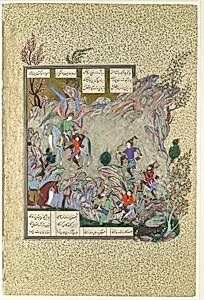
"The Angel Surush Rescues Khusrau Parviz from a Cul-de-sac", Folio 708v from the Shahnama (Book of Kings) of Shah Tahmasp
ca. 1530–35
Medium
Opaque watercolor, ink, silver, and gold on paper
Dimensions
Painting: H. 13 1/2 in. (34.3 cm) W. 11 in. (27.9 cm) Page: H. 18 5/8 in. (47.3 cm) W. 12 3/8 in. (31.4 cm) Mat: H. 22 in. (55.9 cm) W. 16 in. (40.6 cm)
Classification
Codices
Department
Islamic Art
Museum
Metropolitan Museum of Art, New York, NY
Credit
Gift of Arthur A. Houghton Jr., 1970
Accession Number
1970.301.73
Rights
Public Domain
Tags
Art Historical Context
Step into the majestic world of Persian epic poetry with this exquisite folio from the *Shahnama* (Book of Kings) of Shah Tahmasp. Titled "The Angel Surush Rescues Khusrau Parviz from a Cul-de-sac," Folio 708v captures a pivotal moment where the benevolent angel Surush swoops in to save the Sasanian king Khusrau Parviz from a deadly trap. Created around 1530–35 during the Safavid dynasty in Persia (modern Iran), this scene pulses with drama, featuring dynamic horses, armored men, and the divine winged figure amid a rugged landscape. Illustrated by the masterful Muzaffar 'Ali and drawn from the verses of the poet Abu'l Qasim Firdausi, the folio is part of one of history's greatest illuminated manuscripts, commissioned by Shah Tahmasp as a symbol of royal patronage and cultural splendor. The *Shahnama*, completed around 1010 CE, chronicles Iran's mythical kings and heroes, blending history, legend, and moral tales to affirm Persian identity under Islamic rule. Crafted with opaque watercolor, ink, silver, and gold on paper, the artwork exemplifies Safavid miniature painting's technical brilliance—vibrant hues, intricate gold detailing, and silver highlights that shimmer like starlight. Measuring about 13½ by 11 inches, this jewel from the Metropolitan Museum of Art's Islamic Art collection invites viewers to ponder themes of divine intervention and heroism that have captivated audiences for centuries.
About the Artist
Abu'l Qasim Firdausi|Muzaffar 'Ali · 935–1020
Abu'l Qasim Firdausi, born around 940 in the village of Paj near Tus in Khorasan (modern-day Iran), emerged from a family of landed gentry known as dehqans, who preserved ancient Iranian oral traditions amid the cultural renaissance of the Samanid Empire. Little is documented about his early life or formal training, though he likely received a basic education including Arabic literacy, immersing h...