
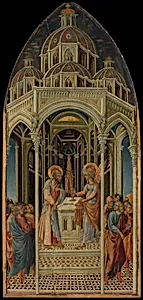
The Annunciation to Zacharias; (verso) The Angel of the Annunciation
Medium
Tempera and gold on wood
Dimensions
Overall: 29 7/8 in. × 17 in. (75.9 × 43.2 cm)
Classification
Paintings
Department
Robert Lehman Collection
Museum
Metropolitan Museum of Art, New York, NY
Credit
Robert Lehman Collection, 1975
Accession Number
1975.1.37
Rights
Public Domain
Tags
Art Historical Context
Step into the luminous world of 15th-century Sien painting with Giovanni di Paolo's *The Annunciation toarias* (recto) and *The Angel of theunciation* (verso created around 1455–60. This double-sided panel, executed in tempera and gold on wood (29 7/8 × 17 in.), hails from the Robert Lehman Collection at the Metropolitan of Art. Giovanni di Paolo, a master Siena's vibrant Gothic tradition, infused his works with fantastical landscapes, expressive figures, and a jewel-like intensity, blending late medieval piety with early Renaissance innovation. The recto depicts a pivotal biblical moment from the Gospel of Luke: the angel Gabriel appears to the priest Zacharias in the temple, foretelling the birth of his son, Saint John the Baptist—John the Baptist, precursor to Christ. On the verso, the elegant Angel of the Annunciation evokes divine grace, its gilded halo and flowing robes shimmering against a rich gold ground. Tempera, a fine egg-based paint, allowed for intricate details and jewel-toned colors, while abundant gold leaf symbolized heavenly light, a hallmark of Italian panel painting for altarpieces and predellas. This artwork captures Siena's devotion to sacred narrative, where angels and saints bridge earth and heaven. Its compact scale suggests it once adorned a private devotional object or altar, inviting contemplation of prophecy and faith amid Renaissance Italy's spiritual fervor. A gem of the Lehman Collection, it showcases Giovanni di Paolo's whimsical yet profound style, enchanting visitors today.