
The Apotheosis of Emperor Maximilian II
16th century
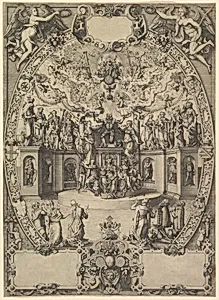
Medium
Etching on two sheets; proof state
Dimensions
sheet: 27 x 19 1/2 in. (68.6 x 49.5 cm)
Classification
Prints
Department
Drawings and Prints
Museum
Metropolitan Museum of Art, New York, NY
Credit
Purchase, Anne Stern Gift, Charles Z. Offin Fund, A. Hyatt Mayor Purchase Fund, Marjorie Phelps Starr Bequest, Elizabeth Eustis Gift, and Martha Feltenstein Gift, 1998
Accession Number
1998.67
Rights
Public Domain
Tags
Art Historical Context
Behold *The Apotheosis of Emperor Maximilian II*, a monumental 16th-century etching crafted by the collaborative talents of Jost Amman, a prolific Swiss-born engraver and illustrator, and Wenzel Jamnitzer, a renowned Nuremberg goldsmith and designer. This proof-state impression, printed on two large sheets measuring 27 x 19½ inches, captures the divine elevation—or apotheosis—of Holy Roman Emperor Maximilian II (r. 1564–1576), surrounded by angels and allegorical male figures, symbolizing his imperial glory and heavenly ascent. Created in the vibrant printmaking hub of Nuremberg during the Renaissance, the work reflects the era's fascination with imperial propaganda and classical motifs. Etching, a relatively new technique at the time, allowed for intricate lines and tonal depth, showcasing the artists' mastery in rendering ethereal forms and dynamic compositions. As a proof state, this rare early version offers a glimpse into the creative process, with potential corrections visible before final publication. Housed in The Metropolitan Museum of Art's Drawings and Prints department, this piece highlights the cultural role of prints in disseminating ruler iconography across Europe, blending artistry with political reverence. Visitors will appreciate its grandeur, evoking the splendor of Habsburg courts amid religious and humanistic ideals.
About the Artist
Jost Amman|Wenzel Jamnitzer · 1539–1591
Jost Amman (1539–1591) was a Swiss-born woodcut designer, engraver, and illustrator who became one of the most prolific and influential graphic artists of sixteenth-century Germany, producing an output of extraordinary range and technical virtuosity that shaped the visual culture of the later Reformation era. Born in Zurich, Amman moved to Nuremberg around 1560, the city that had been the center o...