
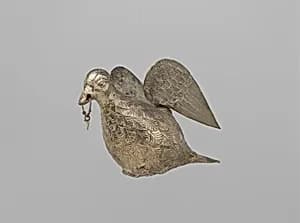
The Attarouthi Treasure - Silver Dove
Unknown Artist
500–650
Medium
Silver
Dimensions
Overall (with wings): 3 5/8 x 6 1/4 x 2 11/16 in. (9.2 x 15.8 x 6.8 cm) Overall (Body only): 2 7/16 x 2 7/16 x 6 1/4 in. (6.2 x 6.2 x 15.8 cm)
Classification
Metalwork-Silver
Culture
Byzantine
Department
Medieval Art
Museum
Metropolitan Museum of Art, New York, NY
Credit
Purchase, Rogers Fund and Henry J. and Drue E. Heinz Foundation, Norbert Schimmel, and Lila Acheson Wallace Gifts, 1986
Accession Number
1986.3.15
Rights
Public Domain
Tags
Art Historical Context
Nestled within the Attarouthi Treasure, delicate silver dove from Byzantine Syria (circa 500–650 AD) captivates with its lifelike form. Measuring about 3⅝ x 6¼ x 2⅝ inches with wings extended, the bird perches elegantly, its body slightly under 2½ inches square. Crafted by an unknown artisan, it exemplifies the exquisite metalwork of early Byzantine culture, blending realism with symbolic grace in the Medieval Art tradition. Discovered in present-day Syria, the Attarouthi Treasure comprises liturgical objects from a church hoard, buried likely during the Persian or Arab invasions. Doves held profound Christian symbolism here, evoking the Holy Spirit, peace, and divine presence—echoing biblical motifs like Noah's dove or Christ's baptism. This piece reflects the opulent silvercraft of the Eastern Roman Empire, where such items adorned altars or processions, bridging late antiquity and the medieval world. The Met's acquisition in 1986 via generous gifts preserved this rarity, showcasing Byzantine silversmiths' mastery of chasing and repoussé techniques for shimmering detail. A testament to faith amid turmoil, it invites us to ponder the artistry that endured centuries underground.