
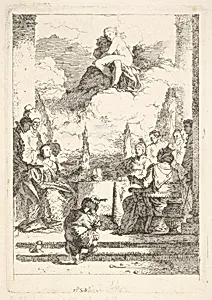
The Banquet of Anthony and Cleopatra
Medium
Etching; first state of two
Dimensions
Sheet: 9 3/16 x 6 7/8 in. (23.3 x 17.5 cm) Plate: 6 1/2 x 4 7/16 in. (16.5 x 11.3 cm) Image: 5 13/16 × 4 3/16 in. (14.8 × 10.6 cm)
Classification
Prints
Department
Drawings and Prints
Museum
Metropolitan Museum of Art, New York, NY
Credit
Bequest of Phyllis Massar, 2011
Accession Number
2012.136.385
Rights
Public Domain
Tags
Art Historical Context
This delicate etching, created around 1764, presents the legendary banquet of Mark Antony and Cleopatra. The work is attributed to both Jean-Honoré Fragonard and Giovanni Battista Tiepolo, reflecting a fascinating collaboration or reproductive effort between the French Rococo master and the celebrated Venetian painter. Measuring just over five inches in height, the small plate captures an intimate yet grand scene of feasting and opulence, drawn from the ancient story of political alliance and romance. Rendered in the first state of two, the print showcases the fine lines and tonal subtleties possible in early impressions of etching. This medium allowed 18th-century artists to disseminate dramatic historical narratives to wider audiences beyond the original paintings or frescoes. Fragonard’s lively touch and Tiepolo’s theatrical compositions merge here, evoking the Rococo interest in elegance, movement, and classical themes reimagined for contemporary viewers. Housed in the Metropolitan Museum of Art’s Department of Drawings and Prints, this work offers a window into how Enlightenment-era artists reinterpreted antiquity. Its modest scale invites close looking, rewarding visitors with details of the banquet’s lavish setting and the human figures that animate this timeless tale.
About the Artist
Jean Honoré Fragonard|Giovanni Battista Tiepolo · 1732–1806
Jean-Honoré Fragonard (1732-1806) was a French painter and printmaker whose late Rococo manner was distinguished by remarkable facility, exuberance, and hedonism. Born in Grasse, he moved to Paris where he trained under Jean-Baptiste Chardin and François Boucher, winning the prestigious Prix de Rome in 1752. After studying in Italy alongside Hubert Robert, Fragonard returned to Paris in 1761 to fi...