
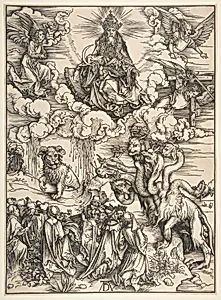
The Beast with the Seven Heads and the Beast with Lamb's Horns
1511
Medium
Woodcut
Dimensions
sheet: 15 1/8 x 11 in. (38.4 x 27.9 cm)
Classification
Prints
Department
Drawings and Prints
Museum
Metropolitan Museum of Art, New York, NY
Credit
Gift of Junius Spencer Morgan, 1919
Accession Number
19.73.215
Rights
Public Domain
Tags
Art Historical Context
Albrecht Dürer's *The Beast with the Seven Heads and Beast with Lamb's Horn* (1511) is a dramatic woodcut that captures the apocalyptic visions from the Book of Revelation in the Bible. Printed on a large sheet measuring 15 1/8 x 11 inches, it vividly portrays the multi-headed beast symbolizing chaos and evil, alongside the deceptive beast with lamb's horns, surrounded by angels, men, and mythical creatures. These figures evoke the prophetic battles of good versus evil, blending human forms with otherworldly terror to stir the viewer's imagination. As a cornerstone of Dürer's oeuvre, this print belongs to his renowned *Apocalypse* series, first published in 1498 and reissued in Latin in 1511 to reach a broader European audience amid religious upheaval. Dürer, a Northern Renaissance master from Nuremberg, revolutionized woodcuts—a medium typically coarse—through his extraordinary precision, achieving engraving-like detail with fine lines and textures that made complex theological scenes accessible via affordable prints. This technique democratized art, allowing ordinary people to own vivid biblical imagery during the early Reformation. Housed in the Metropolitan Museum of Art's Drawings and Prints department (gift of Junius Spencer Morgan, 1919), the work underscores Dürer's cultural impact: his prints spread Reformation ideas visually, influencing artists for centuries and reminding us how 16th-century fears of the end times resonate through masterful craftsmanship.
About the Artist
Albrecht Dürer · 1471–1528
Albrecht Dürer (1471–1528) stands as the preeminent figure of the Northern Renaissance and arguably the most influential artist in the history of printmaking. Born in Nuremberg on May 21, 1471, and dying in the same city on April 6, 1528, Dürer revolutionized the status of the artist in Northern Europe, transforming printmaking from a commercial craft into an independent fine art and establishing ...