
The Beggars Opera
Medium
Etching; sixth state of six
Dimensions
sheet: 9 5/8 x 10 1/2 in. (24.4 x 26.7 cm)
Classification
Prints
Department
Drawings and Prints
Museum
Metropolitan Museum of Art, New York, NY
Credit
Harris Brisbane Dick Fund, 1917
Accession Number
17.3.888-321
Rights
Public Domain
Tags
Art Historical Context
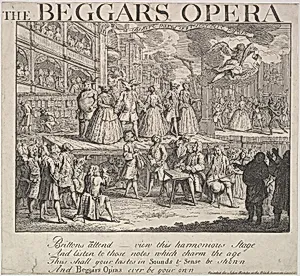
*The Beggar's Opera*, an etching from 1728, captures the vibrant spirit of one of London's most sensational cultural hits. Created in collaboration involving William Hogarth, the era's master of satirical prints, publisher John Bowles, and British artists, this sixth-state impression—measuring 9⅝ × 10½ inches—offers a glimpse into 18th-century theater life. Housed in the Metropolitan Museum of Art's Drawings and Prints department, it reflects the ballad opera by John Gay, a subversive hit that premiered that same year, mocking Italian grand opera and corrupt society through rogues, thieves, and catchy tunes. Hogarth's involvement brings sharp wit and social commentary, hallmarks of his rococo-influenced style. The etching technique, an intaglio process biting acid into metal plates for intricate lines, allowed detailed depictions of musical instruments, opera performers, men, women, and rapt spectators—evoking the packed houses where *The Beggar's Opera* ran for 62 performances, outshining Handel's works. This print, acquired via the Harris Brisbane Dick Fund in 1917, immortalizes a moment when lowbrow entertainment challenged high culture. As a cultural artifact, it highlights 1720s Britain's love for satire and music, blending entertainment with critique. Visitors will appreciate its lively energy, a window into an age of theatrical revolution.
About the Artist
John Bowles|William Hogarth|Anonymous, British, 18th century (British|British|French) · 1700 |1725 |1714 –1755 |1794 |1789
London|British, Sunderland 1725–1794 Bath|French, Avignon 1714–1789 Paris