
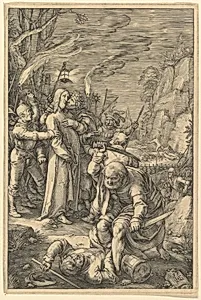
The Betrayal of Christ, from The Passion of Christ
Medium
Engraving;second state of two
Dimensions
sheet: 8 1/16 x 5 3/8 in. (20.5 x 13.7 cm)
Classification
Prints
Department
Drawings and Prints
Museum
Metropolitan Museum of Art, New York, NY
Credit
Gift of Henry Walters, 1917
Accession Number
17.37.40
Rights
Public Domain
Tags
Art Historical Context
In the dimly lit garden of Gethsemane, Hendrick Goltzius captures the dramatic moment of Christ's betrayal in this 1598 engraving from his renowned *Passion of Christ* series Soldiers with drawn daggers close in on Jesus, illuminated by torchlight, as apostles scatter in fear—evoking the biblical account from the Gospels. Goltzius, a Dutch Mannerist engraver (1558–1617), masterfully conveys tension through dynamic figures and expressive gestures, blending northern realism with Italianate elegance inspired by his travels. This intimate print, measuring just 8 x 5 inches, exemplifies Goltzius's revolutionary engraving technique. His swelling, muscular linework mimics the brushstrokes of oil painting, creating depth and volume on metal plate—a hallmark of his innovative printmaking that elevated engraving to fine art status during the late Renaissance. As the second state of two, it may include subtle refinements like added shading, enhancing its chiaroscuro effects. Produced amid the religious upheavals of the Dutch Revolt, this work reflects Counter-Reformation fervor, making devotional imagery accessible via affordable prints. Donated to the Metropolitan Museum of Art in 1917 by Henry Walters, it remains a testament to Goltzius's enduring influence on European graphic arts.
About the Artist
Hendrick Goltzius · 1558–1617
Hendrick Goltzius (1558–1617) was the most celebrated engraver of the Northern Renaissance and a pivotal figure in Dutch Mannerism. Born near the German-Dutch border, Goltzius transformed printmaking into a virtuoso art form through his revolutionary 'swelling line' technique, where the burin was manipulated to create lines of varying thickness that produced unprecedented tonal effects and three-d...