
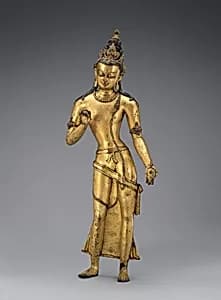
The Bodhisattva Maitreya, the Buddha of the Future
Unknown Artist
11th century
Medium
Copper alloy with gilding and color
Dimensions
H. 26 in. (66 cm); W. 8 1/4 in. (20.9 cm)
Classification
Sculpture
Culture & Period
Nepal · Thakuri period
Department
Asian Art
Museum
Metropolitan Museum of Art, New York, NY
Credit
Rogers Fund, 1982
Accession Number
1982.220.12
Rights
Public Domain
Tags
Art Historical Context
Behold *The Bodhisattva Mya, the Buddha of Future*, a stunning 11th-century copper alloy sculpture from Nepal's Thakuri period, standing gracefully at 26 inches tall. Crafted by an artist, this gilded figure captures Maitreya, the prophesied future Buddha in Buddhist tradition, who will descend to earth when the Dharma is forgotten, ushering in a new era of enlightenment. His serene expression, adorned with vibrant colors and intricate detailing, embodies compassion and hope, inviting devotees to contemplate the cyclical nature of time and salvation. During the Thakuri dynasty (c. 9th–12th centuries), Nepal flourished as a crossroads of Hindu and Buddhist art, blending Indian influences with local Himalayan styles. Artisans skillfully cast this piece in copper alloy—a durable yet malleable medium—then applied gilding for a radiant, divine glow and semiprecious pigments for lifelike flesh tones and jewelry. Such techniques not only enhanced its sacred aura but also ensured longevity in temple rituals, where Maitreya statues served as focal points for meditation and offerings. Acquired through the Rogers Fund in 1982, this masterpiece from the Metropolitan Museum of Art's Asian Art collection highlights Nepal's pivotal role in Mahayana Buddhism. Gaze upon Maitreya's gentle smile and you'll feel the promise of renewal, a timeless reminder of Buddhism's optimistic vision for humanity's future.