
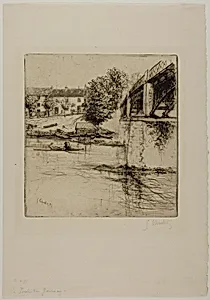
The Bridge at Fournay, from the Side
1895
Medium
Etching and plate tone on ivory laid paper
Dimensions
Image/plate: 16.8 × 16 cm (6 5/8 × 6 5/16 in.); Sheet: 30.4 × 21.3 cm (12 × 8 7/16 in.)
Classification
etching
Department
Prints and Drawings
Museum
Art Institute of Chicago
Accession Number
41358
Rights
Public Domain
Art Historical Context
In the late 19th century, artist Gustave Leheut captured the serene charm of rural France with *The Bridge at Fournay, from the* (1895), an etching housed in the Art Institute of's Prints and Drawings collection This work depicts a quaint stone bridge, likely in the French countryside near Fournay, viewed from an oblique angle that invites viewers to linger on its architectural curves and surrounding landscape. Leheutre, active during a period when printmaking flourished as an accessible art form, contributed to the era's fascination with everyday scenes, bridging Impressionist influences with meticulous technical precision. The artwork's medium—etching and plate tone on ivory laid paper—showcases Leheutre's mastery of intaglio techniques. Etching involves incising lines into a metal plate with acid for sharp, expressive details, while plate tone adds subtle gradations of ink for atmospheric depth, evoking mist or shadow over the bridge's stonework. Measuring just 16.8 × 16 cm, this compact print on a larger sheet (30.4 × 21.3 cm) highlights the intimacy of 19th-century prints, prized for their affordability and reproducibility compared to paintings. As a fine example of fin-de-siècle French printmaking, *The Bridge at Fournay* reflects the cultural shift toward celebrating humble, vernacular architecture amid rapid industrialization, offering visitors a window into a quieter pastoral world.
About the Artist
Gustave Leheutre · 1861–1932
**Gustave Leheutre (1861–1932)** was a French painter, draftsman, and printmaker best known for his sensitive etchings and drypoints of urban and rural French landscapes. Born on July 26, 1861, in Troyes at place Saint-Rémy, he remained deeply attached to his native city throughout his life. His father’s military career led the family through various postings, and Leheutre completed his secondary ...