
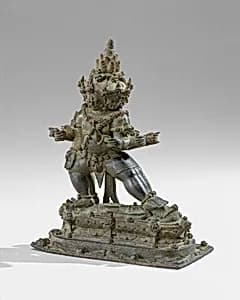
The Buddhist Guardian Mahabala
Unknown Artist
11th century
Medium
Bronze
Dimensions
H. 6 1/2 in. (16.5 cm)
Classification
Sculpture
Culture & Period
Indonesia (Java) · Eastern Javanese period
Department
Asian Art
Museum
Metropolitan Museum of Art, New York, NY
Credit
Gift of Evelyn Kossak, The Kronos Collections, 1995
Accession Number
1995.570.4
Rights
Public Domain
Tags
Art Historical Context
This small bronze sculpture of Mahabala, a fierce Buddhist guardian deity, was created in Java during the 11th century Eastern Javanese period. Standing just 6½ inches tall, the figure exemplifies the refined metalworking traditions of ancient Indonesia, where bronze was cast using the lost-wax method to produce detailed religious icons for temples and personal devotion. As a protector of Buddhist teachings, Mahabala embodies the dynamic blend of Indian Buddhist iconography with local Javanese artistic expressions. During this era, Java flourished as a center of Hindu-Buddhist culture under kingdoms like the Kahuripan and Kediri, fostering art that served both spiritual and royal purposes. Such guardian figures played a vital role in safeguarding sacred spaces and guiding practitioners, reflecting the deep integration of Buddhism into daily life and state rituals. The compact size of this piece suggests it may have been intended for portable altars or private worship, highlighting the accessibility of devotional art beyond grand monuments. Today housed in the Metropolitan Museum of Art as a gift from the Kronos Collections, this sculpture offers visitors a tangible connection to Java’s rich artistic heritage. Its enduring presence underscores the timeless appeal of guardian deities in Buddhist traditions across Southeast Asia.