
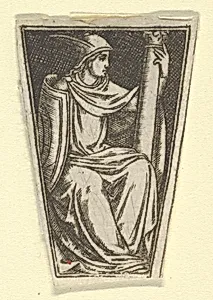
The cardinal virtue of Fortitude represented by a seated woman, her right hand on a column (possibly a modern impression)
ca. 1480–1520
Medium
Engraving, printed from a plate engraved in the niello manner
Dimensions
Sheet: 12 3/16 × 8 1/4 in. (31 × 21 cm)
Classification
Prints
Department
Drawings and Prints
Museum
Metropolitan Museum of Art, New York, NY
Credit
Gift of Leo Steinberg, 1991
Accession Number
1991.1337.1
Rights
Public Domain
Tags
Art Historical Context
This anonymous engraving from around 1480–1520 presents Fortitude, one of the four cardinal virtues, as a seated woman resting her hand on a sturdy column—a timeless symbol of inner strength and resilience. Created during the late Renaissance, when moral allegories flourished in European art, the print reflects the era’s interest in classical ideals revived through Christian teachings. Such images often served as moral guides, encouraging viewers to embody these virtues in daily life. The work’s technique is especially notable: it was printed from a plate engraved in the niello manner, a method rooted in metalwork where lines are filled with a dark alloy before printing. This approach yields rich contrasts and fine detail, bridging decorative arts and early printmaking. As a rare surviving example from this transitional period, it highlights how print technologies helped spread symbolic imagery across social classes. Housed in the Metropolitan Museum of Art’s Department of Drawings and Prints, this sheet (measuring about 31 by 21 cm) was gifted by Leo Steinberg in 1991. Its focus on a female personification underscores the long artistic tradition of representing abstract qualities through women’s figures, inviting contemplation of strength and endurance.
About the Artist
Anonymous
In the vast tapestry of art history, "Anonymous" stands not as a singular individual but as a collective designation for countless unidentified creators whose works have endured across millennia. These artists, spanning prehistoric cave painters to medieval illuminators and folk craftsmen, produced the foundational layers of human visual culture. Prior to the Renaissance, when individual fame emer...