
The Castle
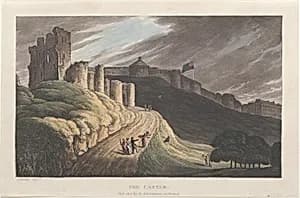
Medium
Hand-colored etching and aquatint
Dimensions
Sheet: 5 3/8 × 8 1/8 in. (13.7 × 20.7 cm)
Classification
Prints
Department
Drawings and Prints
Museum
Metropolitan Museum of Art, New York, NY
Credit
The Elisha Whittelsey Collection, The Elisha Whittelsey Fund, 1959
Accession Number
59.533.1620(9)
Rights
Public Domain
Tags
Art Historical Context
Created in 1813, "The Castle" is a hand-colored etching and aquat that captures the romantic allure of medieval architecture through collaborative efforts of artist James Green, caricaturist Thomas Rowlandson, and publisher Rudolph Ackermann in London. Rowlandson, renowned for his and often humorous scenes, brought a distinctive to topographical and architectural during the Regency era. The medium itself was highly popular at the time, allowing for detailed line work via etching combined with the tonal richness of aquatint, all enhanced by delicate hand-coloring that made each impression unique. This print reflects the early nineteenth-century fascination with castles as symbols of national heritage and picturesque beauty, especially amid Britain’s growing interest in its medieval past. Ackermann’s firm played a key role in disseminating such images through illustrated books and portfolios, making art accessible to a wider audience beyond elite collectors. Measuring just over five by eight inches, the work exemplifies the intimate scale of many prints from the period, inviting close viewing of architectural details and atmospheric effects. Now part of the Metropolitan Museum’s Elisha Whittelsey Collection, it offers a charming glimpse into Regency printmaking traditions.
About the Artist
James Green|Rudolph Ackermann, London|Thomas Rowlandson (British|American) · 1771 |1738 –1834 |1820
British, Leytonstone 1771–1834 Bath|American, Swarthmore, Pennsylvania 1738–1820 London