
The Causeway Across the Vaigai River
January–March 1858
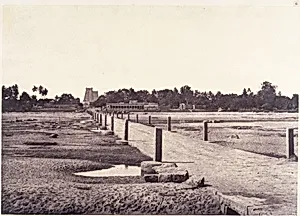
Medium
Albumen silver print from waxed paper negative
Dimensions
Image: 24.9 x 35 cm (9 13/16 x 13 3/4 in.) Mount: 45.2 x 57.5 cm (17 13/16 x 22 5/8 in.)
Classification
Photographs
Department
Photographs
Museum
Metropolitan Museum of Art, New York, NY
Credit
Gilman Collection, Purchase, Cynthia Hazen Polsky Gift, 2005
Accession Number
2005.100.381.1.6
Rights
Public Domain
Tags
Art Historical Context
Linnaeus Tripe created *The Causeway Across the Vaigai River* during his extensive photographic expedition through southern India in early 1858. As a captain in the British East India Company, Tripe documented landscapes, architecture, and infrastructure across the Madras Presidency, producing hundreds of images that introduced Western audiences to the region’s terrain. This view of the causeway—a raised roadway spanning the river—captures both the practical engineering of travel routes and the serene expanse of water and land beyond. The photograph is an albumen silver print made from a waxed paper negative, a technique Tripe refined for its portability and ability to record fine detail in bright sunlight. The medium’s soft tonal range beautifully renders the textures of the road, riverbanks, and distant horizon, lending the scene a luminous, almost painterly quality. Measuring roughly ten by fourteen inches, the print was mounted on a larger sheet for presentation, reflecting the careful craftsmanship typical of early topographical photography. Today housed in the Metropolitan Museum of Art’s Gilman Collection, the image offers modern viewers a rare, firsthand glimpse of mid-nineteenth-century India through the eyes of one of its earliest and most accomplished photographic explorers.
About the Artist
Linnaeus Tripe · 1822–1902
Linnaeus Tripe (1822–1902), born in Devonport, England, as the ninth of twelve children to Mary and Cornelius Tripe, pursued a military career influenced by his sister Emily's marriage to an army colonel. Joining the East India Company's Madras Infantry as a cadet in 1838, he rose to lieutenant in southern India by 1840 and captain in Bangalore by 1854. Extended leave in England from 1850 due to i...