
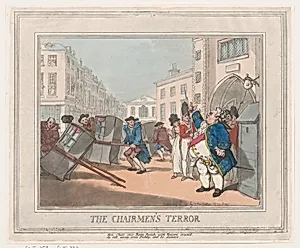
The Chairmen's Terror
July 18, 1792
Medium
Hand-colored etching
Dimensions
Sheet: 9 3/4 × 11 3/4 in. (24.7 × 29.8 cm)
Classification
Prints
Department
Drawings and Prints
Museum
Metropolitan Museum of Art, New York, NY
Credit
The Elisha Whittelsey Collection, The Elisha Whittelsey Fund, 1959
Accession Number
59.533.465
Rights
Public Domain
Tags
Art Historical Context
Thomas Rowlandson's *The Chairmen's Terror* (1792) is a lively hand-colored etching that captures the chaotic energy of late 18th-century London street life. Created as a satirical print, it belongs to Rowlandson's vast oeuvre of caricatures, which poked fun at social customs, urban mishaps, and human folly during the Georgian era. Published on July 18, 1792, amid Britain's growing fascination with French Revolutionary fervor, the work likely satirizes the perils of sedan chairs—enclosed litters carried by "chairmen"—a common mode of transport for the upper classes navigating crowded city streets. The scene, inferred from its title and tags featuring buildings, men, and women, depicts a comical catastrophe: flustered chairmen in panic, perhaps tumbling with passengers amid the bustle of Regency-era architecture. Rowlandson's etching technique—sharp, expressive lines incised into a metal plate—allows for dynamic composition, while the hand-applied watercolor enhances the vividness and humor, making the print a standout in affordable, mass-produced satire. Measuring 9 3/4 × 11 3/4 inches, it's perfectly sized for display in parlors or taverns, where such works fueled public discourse. Housed in the Metropolitan Museum of Art's Elisha Whittelsey Collection, this piece exemplifies the golden age of British caricature, blending artistry with sharp social commentary. Rowlandson's loose, energetic style influenced later illustrators, reminding us how prints like this democratized wit and critique for everyday audiences.
About the Artist
Thomas Rowlandson · 1756–1827
Thomas Rowlandson (1757–1827) was an English artist and caricaturist whose satirical watercolors and prints captured the social life of Georgian Britain with unparalleled wit and technical mastery. Alongside James Gillray, he is recognized as one of the greatest British graphic artists, and his distinctive flowing line and keen observations have made his work integral to understanding late 18th an...