
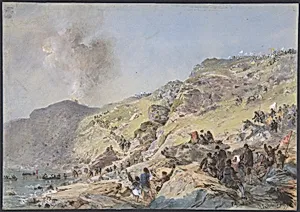
The Cliffs, Foilhummerum Bay, Valentia, the Point at Which the Shore-end of the Cable was Landed on July 22nd, 1865
Medium
Watercolor over graphite with touches of gouache (bodycolor)
Dimensions
Sheet: 6 7/16 × 9 5/16 in. (16.4 × 23.6 cm)
Classification
Drawings
Department
Drawings and Prints
Museum
Metropolitan Museum of Art, New York, NY
Credit
Gift of Cyrus W. Field, 1892
Accession Number
92.10.60
Rights
Public Domain
Tags
Art Historical Context
In the rugged cliffs of Foilhummer Bay on Valentia Island, Ireland, Charles Dudley captured a monumental moment in 1865: the landing of the shore-end of transatlantic telegraph cable on 22. This watercolor depicts the precise point where crews from the steamship *Great Eastern*—the largest vessel of its time—began connecting Europe and North America via instantaneous communication. The scene buzzes with industry, featuring boats bobbing amid dramatic hills and sheer rock faces, symbolizing humanity's bold push into the technological frontier during the Industrial Revolution. Dudley, an artist who chronicled the cable expeditions, employed watercolor over graphite with subtle gouache highlights, a portable medium ideal for on-site sketching. This technique lent luminous depth to the coastal landscape, balancing meticulous graphite underdrawing with fluid washes that evoke the sea's restless energy and the cliffs' imposing scale (6 7/16 × 9 5/16 in.). A gift to the Metropolitan Museum of Art from Cyrus W. Field—the visionary financier behind the project—this drawing preserves the grit and triumph of an era when undersea cables shrank the world, paving the way for modern global connectivity. Visitors, imagine the cheers echoing off these cliffs as history wired itself together!
About the Artist
Robert Charles Dudley · 1813–1913
British, 1826–1909