
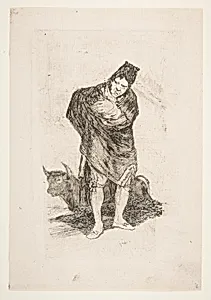
The cloaked man
Medium
Etching, drypoint
Dimensions
Plate: 7 1/2 × 4 3/4 in. (19 × 12 cm) Sheet: 9 3/16 × 6 1/4 in. (23.4 × 15.9 cm)
Classification
Prints
Department
Drawings and Prints
Museum
Metropolitan Museum of Art, New York, NY
Credit
Harris Brisbane Dick Fund, 1923
Accession Number
23.37.5
Rights
Public Domain
Tags
Art Historical Context
Francisco de Goya y Lucientes (1746–1828), the visionary Spanish artist of the Romantic era, created *The Cloaked Man* as a striking etching and drypoint print. Though dated 1859—likely referring to a posthumous impression pulled from Goya's original plates—this work exemplifies his mastery of intaglio techniques. Etching involves incising lines into a copper plate with acid for precise, fluid forms, while drypoint adds a tactile burr from direct needle scratches, yielding rich, velvety textures and dramatic shadows. Measuring a compact plate size of 7½ × 4¾ inches, it invites close inspection, revealing Goya's innovative blend of technical precision and emotional depth. Goya's prints, including this one from the Metropolitan Museum of Art's Drawings and Prints collection (acquired via the Harris Brisbane Dick Fund in 1923), often captured the human condition amid Spain's turbulent late 18th- and early 19th-century upheavals—war, superstition, and social critique. Tagged with motifs of men and animals, *The Cloaked Man* evokes mystery and menace, perhaps alluding to folklore figures or the artist's fascination with the irrational, as seen in series like *Los Caprichos*. Its shadowy figure shrouded in a cloak embodies Goya's shift toward introspective, psychologically charged imagery, bridging Enlightenment rationality and Romantic expressiveness. This intimate print highlights Goya's enduring influence on modern graphic arts, offering visitors a window into his fearless exploration of darkness and humanity.
About the Artist
Goya (Francisco de Goya y Lucientes) · 1746–1828
Francisco José de Goya y Lucientes (1746-1828) was a Spanish painter and printmaker considered the last of the Old Masters and the first of the moderns. Rising from modest provincial origins to become First Court Painter to Charles IV, Goya's career spanned the Enlightenment's optimism and the brutal Napoleonic invasion that shattered it. A mysterious illness in 1793 left him permanently deaf and ...