
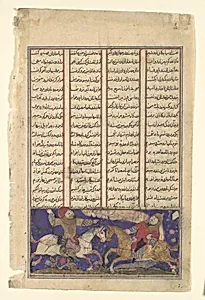
"The Combat of Khusrau Parviz and Bahram Chubina (?)", Folio from a Shahnama (Book of Kings)
ca. 1330–40
Medium
Ink, opaque watercolor, gold, and silver on paper
Dimensions
Page: H. 8 1/16 in. (20.5 cm) W. 5 1/4 in. (13.3 cm) Painting: H. 1 15/16 in. (5 cm) W. 4 5/16 in. (10.9 cm)
Classification
Codices
Department
Islamic Art
Museum
Metropolitan Museum of Art, New York, NY
Credit
Bequest of Monroe C. Gutman, 1974
Accession Number
1974.290.42
Rights
Public Domain
Tags
Art Historical Context
Step into the vibrant world of Persian epic poetry with this exquisite folio from a *Shahnama* (Book of Kings), the monumental epic composed by Abu'l Qasim Firda around 1010 CE. Dating to circa 1330–40, this page captures "The Combat of Khus Parviz and Bahramubina," a dramatic clash between the Sasanian king Khus Parviz (Khosrow II) and the rebel general Bahram Chobin. a national treasure of Iranian literature, the *Shahnama* chronicles over 50 kings through myth, history, and moral tales, blending heroism with tragedy to affirm Persian identity. Crafted during the Ilkhanid period under Mongol rule in Persia, this manuscript illumination exemplifies early Persian miniature painting. The small painting (just under 2 by 4 ½ inches) bursts with action: rearing horses, armored warriors in fierce combat, rendered in ink, opaque watercolor, gold, and silver on paper. These luxurious materials create a luminous, jewel-like quality, with gold highlighting adding divine sparkle to the chaotic fray. Such codices were prized treasures for royal courts, merging text and image to bring Firdausi's verses alive. Housed in the Metropolitan Museum of Art's Islamic Art Department, this folio (bequeathed by Monroe C. Gutman in 1974) showcases the cultural synthesis of Persian storytelling and Islamic artistic refinement, inviting us to relive ancient valor on a delicate page.
About the Artist
Abu'l Qasim Firdausi · 935–1020
Abu'l Qasim Firdausi, born around 940 in the village of Paj near Tus in Khorasan (modern-day Iran), emerged from a family of landed gentry known as dehqans, who preserved ancient Iranian oral traditions amid the cultural renaissance of the Samanid Empire. Little is documented about his early life or formal training, though he likely received a basic education including Arabic literacy, immersing h...