
The Common Marigold and The Rajoman Flowers
19th century
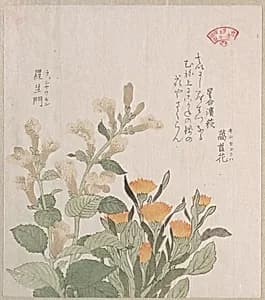
Medium
Part of an album of woodblock prints (surimono); ink and color on paper
Dimensions
8 1/4 x 7 1/4 in. (21 x 18.4 cm)
Classification
Prints
Culture
Japan
Department
Asian Art
Museum
Metropolitan Museum of Art, New York, NY
Credit
H. O. Havemeyer Collection, Bequest of Mrs. H. O. Havemeyer, 1929
Accession Number
JP2311
Rights
Public Domain
Tags
Art Historical Context
Behold *The Common Marigold and The Rajoman Flowers*, a delicate 19th-century woodblock print by Kubo Shunman, a master of Japan's ukiyo-e tradition. Part of a luxurious surimono album—ately commissioned prints often exchanged as New Year's greetings—this intimate work (8¼ x 7¼ in.) captures vibrant marigolds and Rajoman flowers amid lush leaves. Rendered in ink and color on paper, it exemplifies Shunman's poetic finesse, blending precise botanical detail with subtle elegance. Surimono like this one were artisanal treasures, produced in limited editions with techniques such as embossing and mica dusting for a shimmering effect, elevating them beyond standard prints. Shunman, active during the late Edo period, infused his designs with kyōka poetry and nature's fleeting beauty, reflecting Japan's wabi-sabi aesthetic—celebrating impermanence through flowers that bloom briefly. Housed in the Metropolitan Museum of Art's Asian Art collection (H. O. Havemeyer Collection, 1929), this piece highlights the cultural reverence for flora in Japanese art, symbolizing seasons and harmony. A window into elite Edo society, it invites visitors to savor the quiet splendor of everyday wonders.
About the Artist
Kubo Shunman · 1757–1820
Japanese, 1757–1820