
The Company of Undertakers
after 1736
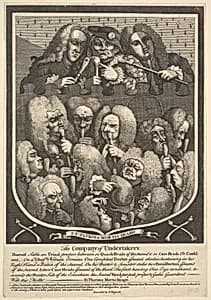
Medium
Engraving
Dimensions
sheet: 10 5/16 x 7 1/16 in. (26.2 x 18 cm)
Classification
Prints
Department
Drawings and Prints
Museum
Metropolitan Museum of Art, New York, NY
Credit
Harris Brisbane Dick Fund, 1932
Accession Number
32.35(256)
Rights
Public Domain
Tags
Art Historical Context
William Hogarth's *The Company of Undertakers*, an engraving created after 1736, exemplifies the artist's razor-sharp satire of 18th-century British society. Hogarth (1697–1764), a English painter and printmaker, was renowned for his moralistic series that exposed human folly, vice, and institutional corruption. This compact work (10 5/16 x 7 1/16 in.) features a group of men, likely portraying undertakers in a darkly humorous light, critiquing professions tied to death and misfortune amid the Enlightenment era's growing skepticism toward authority. As an engraving, the piece showcases Hogarth's mastery of the intaglio technique, where intricate lines etched into a metal plate allowed for rich tonal contrasts and narrative detail when printed. Prints like this were revolutionary, making high art affordable and widely accessible to the middle class, amplifying their social commentary. Housed in the Metropolitan Museum of Art's Drawings and Prints department (Harris Brisbane Dick Fund, 1932), it reflects Hogarth's blend of caricature and realism. Culturally, *The Company of Undertakers* underscores Hogarth's role in shaping satirical visual culture, influencing later cartoonists and social reformers. Visitors, imagine the chuckles (and chills) it provoked in London's coffeehouses— a timeless reminder of mortality's absurdities.
About the Artist
William Hogarth · 1697–1764
William Hogarth (1697-1764) was an English painter, printmaker, and pictorial satirist who became the first great English-born artist to attract admiration abroad. Born into poverty in London, the son of a failed schoolmaster who was imprisoned for debt, Hogarth's early experiences with the harsh realities of 18th-century urban life profoundly shaped his artistic vision. After apprenticing with si...