
The Contrast
December 1792
Medium
Etching
Dimensions
Sheet: 11 1/16 × 16 1/2 in. (28.1 × 41.9 cm) Plate: 10 3/4 × 14 13/16 in. (27.3 × 37.7 cm)
Classification
Prints
Department
Drawings and Prints
Museum
Metropolitan Museum of Art, New York, NY
Credit
The Elisha Whittelsey Collection, The Elisha Whittelsey Fund and Harris Brisbane Dick Fund, by Exchange, 1970
Accession Number
1970.541.59
Rights
Public Domain
Tags
Art Historical Context
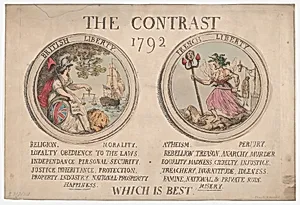
Thomas Rowlandson’s *The Contrast* (December 1792) is a quintessential example of the artist’s sharp-witted satirical etchings from the late Georgian era. A master caricaturist, Rowlandson produced thousands of prints lampooning British society’s follies, from politics to everyday vices. This hand-pulled etching, measuring about 11 by 16 inches, captures his fluid line work and exaggerated figures, hallmarks of a technique that allowed for intricate details and rapid commentary on contemporary life. Etching’s acidic bite into copper plates enabled affordable, reproducible satires that circulated widely among the public. The title hints at a moral dichotomy, vividly evoked through tags like Devil, Goddess, and Boats. Likely depicting infernal chaos against divine serenity—perhaps rival vessels symbolizing vice versus virtue—Rowlandson uses humor to contrast human indulgences with ideals of propriety. Created amid the French Revolution’s upheavals and Britain’s social tensions, it reflects the era’s obsession with morality tales in visual form. Housed in the Metropolitan Museum of Art’s Drawings and Prints department, thanks to the Elisha Whittelsey Collection, *The Contrast* exemplifies the golden age of British caricature. Rowlandson’s playful yet pointed style influenced later illustrators, offering visitors a window into 18th-century wit and cultural critique.
About the Artist
Thomas Rowlandson · 1756–1827
Thomas Rowlandson (1757–1827) was an English artist and caricaturist whose satirical watercolors and prints captured the social life of Georgian Britain with unparalleled wit and technical mastery. Alongside James Gillray, he is recognized as one of the greatest British graphic artists, and his distinctive flowing line and keen observations have made his work integral to understanding late 18th an...