
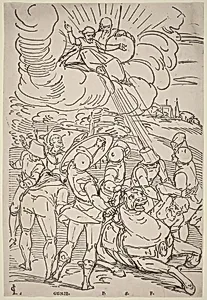
The Conversion of Saint Paul
Medium
woodcut on laid paper
Dimensions
sheet: 42.3 x 28.6 cm (16 5/8 x 11 1/4 in.)
Classification
Department
CG-E
Museum
National Gallery of Art, Washington, D.C.
Credit
Ailsa Mellon Bruce Fund
Accession Number
1983.15.1
Rights
Public Domain
Art Historical Context
Behold *The Conversion of Saint Paul a striking woodcut on laid paper created around 1600 by the enigmatic Master G.G.N. a design by the renowned Genoese Mannerist painter Luca Cambiaso (1527–1585). This print captures the dramatic biblical moment from the Acts of the Apostles, when Saul—later Saint Paul—is struck blind by a divine light on the road to Damascus, tumbling from his horse as Christ's voice calls from the heavens. Cambiaso's influence shines through in the elongated figures and dynamic composition, hallmarks of Mannerism's elegant distortion and emotional intensity. Printed on a generous sheet measuring 42.3 x 28.6 cm, this woodcut exemplifies early 17th-century reproductive printmaking, a technique where skilled engravers like Master G.G.N. translated paintings into affordable, mass-producible images. Woodcuts, carved in relief on wood blocks, allowed for bold lines and rich tonal contrasts, making complex religious narratives accessible to a wide audience during the Counter-Reformation era. This period saw the Catholic Church leveraging art to reaffirm faith, and prints like this one spread devotional imagery far beyond elite patrons. Acquired through the Ailsa Mellon Bruce Fund and housed in the National Gallery of Art's Prints department (CG-E), the work highlights the pivotal role of prints in democratizing art. Visitors will appreciate its technical finesse and the way it freezes a transformative miracle, inviting reflection on faith's blinding power.