
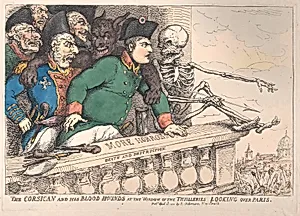
The Corsican and His Bloodhounds at the Window of the Thuilleries Looking Over Paris
Medium
Hand-colored etching
Dimensions
Plate: 9 5/8 × 13 11/16 in. (24.5 × 34.7 cm) Sheet: 11 13/16 × 19 1/8 in. (30 × 48.5 cm)
Classification
Prints
Department
Drawings and Prints
Museum
Metropolitan Museum of Art, New York, NY
Credit
The Elisha Whittelsey Collection, The Elisha Whittelsey Fund, 1959
Accession Number
59.533.1971
Rights
Public Domain
Tags
Art Historical Context
This hand-colored etching, published by Rudolph Ackermann in London on April 16, 1815, offers a sharp satirical glimpse into the turbulent politics of Napoleonic Europe. Created by the celebrated British caricaturist Thomas Rowlandson, the print portrays Napoleon Bonaparte—derisively called “the Corsican”—at the window of the Tuileries Palace, surveying Paris alongside menacing bloodhounds. The inclusion of skeletons and a devilish figure among the tags underscores the work’s biting commentary on the emperor’s return from exile during the Hundred Days. Rowlandson’s lively line work and the vibrant hand-coloring typical of early nineteenth-century prints made such images both affordable and widely circulated, turning political critique into popular visual entertainment. Produced just weeks after Napoleon’s dramatic escape from Elba, the etching reflects British anxieties and hostility toward the emperor’s renewed threat to European stability. Today in the Metropolitan Museum’s collection, the print stands as a vivid reminder of how art served as a powerful weapon in the propaganda wars of the Napoleonic era. Its exaggerated imagery captures the era’s fears while showcasing the expressive potential of etching as a medium for social and political commentary.
About the Artist
Rudolph Ackermann, London|Napoléon Bonaparte|Thomas Rowlandson · 1794–1832
**Rudolph Ackermann (1764–1834)** was a pivotal Anglo-German publisher, printseller, and entrepreneur whose London-based business shaped Regency-era visual culture through innovative printmaking and illustrated publications. Born in Stollberg, Saxony, he trained as a saddler and coach-builder before moving to London around 1787. He initially worked in carriage design and related trades, later esta...