
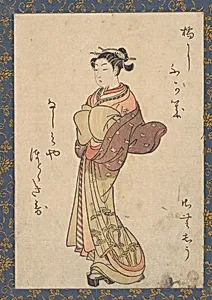
青楼美人合|The Courtesans, from the series, "Seiro Bijin Awase Carver End Shigoro" (sic)
ca. 1765
Medium
Woodblock print; ink and color on paper
Dimensions
8 1/2 x 5 3/4 in. (21.6 x 14.6 cm)
Classification
Prints
Culture & Period
Japan · Edo period (1615–1868)
Department
Asian Art
Museum
Metropolitan Museum of Art, New York, NY
Credit
Rogers Fund, 1917
Accession Number
JP227
Rights
Public Domain
Tags
Art Historical Context
Suzuki Harunobu's *The Courtesans*, from the series *Seō Bijin Awase* (ca. 1765), captures the alluring world of Edo-period Japan's Yoshiwara pleasure district. This intimate woodblock print, measuring just 8½ x 5¾ inches, depicts elegant courtesans—high-ranking courtesans known as *oiran*—in a beauty contest format popular in ukiyo-e, or "pictures of the floating world." Harunobu, a master of the genre, pioneered full-color *nishiki-e* prints around this time, using layered inks to achieve vibrant, lifelike hues that brought these ephemeral scenes to vivid life. Printed with ink and color on paper, the work showcases Harunobu's innovative techniques: precise carving by artisans like the noted Shigoro, and subtle gradations (*bokashi*) for depth and texture. Its small scale suggests it was designed for personal albums or private appreciation, reflecting the period's booming urban culture amid economic prosperity during the Edo era (1615–1868). Culturally, such prints celebrated feminine beauty and wit, idealizing courtesans as cultural icons while offering a glimpse into Japan's vibrant entertainment districts. Acquired through the Rogers Fund in 1917, this Metropolitan Museum of Art treasure invites visitors to ponder the artistry behind fleeting pleasures.
About the Artist
Suzuki Harunobu · 1725–1770
Suzuki Harunobu (c. 1725-1770) was a Japanese ukiyo-e artist who revolutionized woodblock printing by developing nishiki-e—full-color prints using multiple woodblocks—in 1765. Before Harunobu, Japanese prints were limited to two or three colors; his innovation unleashed the entire artist's palette, transforming ukiyo-e into the vibrant art form that would later captivate Western artists from Manet...