
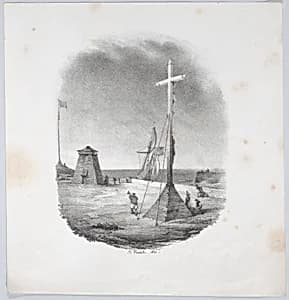
The Cross of the Sailors–Dieppe
1821
Medium
Lithograph; only state
Dimensions
Sheet: 8 9/16 × 8 1/4 in. (21.7 × 21 cm)
Classification
Prints
Department
Drawings and Prints
Museum
Metropolitan Museum of Art, New York, NY
Credit
The Elisha Whittelsey Collection, The Elisha Whittelsey Fund, 1959
Accession Number
59.500.424
Rights
Public Domain
Art Historical Context
Step into the world of early 19th-century France with Horace Vernet's *The Cross of the Sailors–Die* (1821), a delicate lithograph measuring just 8 9/16 × 8 1/4 inches. Vernet, a leading Romantic renowned for his dynamic history paintings and military scenes, captured this poignant scene from the coastal town of Dieppe, a port known for its seafaring community. The title evokes a sacred cross tied to sailors' lives, blending faith and maritime peril in a single, evocative image. Lithography, a revolutionary medium invented just two decades earlier, allowed artists like Vernet to draw directly on limestone with greasy crayon, producing rich tonal effects and subtle details unachievable in earlier print techniques. This "only state" impression—meaning no variant editions exist—highlights its rarity and the artist's direct involvement in the printing process, making it a prized example of lithography's artistic potential during its explosive rise in post-Napoleonic Europe. Housed in the Metropolitan Museum of Art's Drawings and Prints department through The Elisha Whittelsey Collection, this work reflects Romanticism's fascination with everyday heroism and spirituality amid industrial change. Imagine sailors pausing at this humble cross before braving the Channel's storms—a timeless emblem of devotion and resilience.