
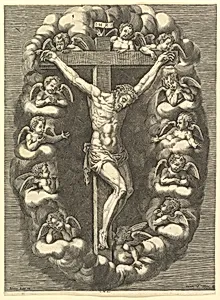
The Crucified Christ Surrounded by Mourning Angels
Medium
Engraving
Dimensions
sheet: 13 3/16 x 9 5/8 in. (33.5 x 24.4 cm); trimmed
Classification
Prints
Department
Drawings and Prints
Museum
Metropolitan Museum of Art, New York, NY
Credit
The Elisha Whittelsey Collection, The Elisha Whittelsey Fund, 1951
Accession Number
51.501.655
Rights
Public Domain
Tags
Art Historical Context
Behold *The Crucified Christ Sur by Mourning Angels*, a poignant 16th- to 17th-century engraving attributed variously to Giorgio Ghisi, anonymous Italian artist, or Frans van denngaerde. Created between 1575 and 1679, this trimmed sheet measures 13 /16 x 9 5/8 inches and the intricate artistry of Renaissance printmaking. Housed in the Metropolitan Museum of Art's Drawings and Prints department as part of The Elisha Whittelsey Collection, captures a deeply emotional moment from Christian iconography. The composition centers on the crucified Christ, enveloped by sorrowful angels whose expressive poses heighten the drama of mourning and redemption. Such scenes proliferated in Counter-Reformation Europe, where vivid religious imagery stirred devotion amid Catholic revival. Engraving, the medium here, involved incising fine lines into a copper plate for inked impressions, enabling widespread dissemination of sacred art to the faithful beyond grand altarpieces. This print's technical precision—likely showcasing Ghisi's renowned Mannerist finesse or Wyngaerde's detailed Flemish touch—made complex theological narratives accessible. Trimmed edges hint at its handling over centuries, preserving a timeless meditation on sacrifice and divine love for today's visitors.
About the Artist
Giorgio Ghisi|Anonymous, Italian, 16th century|Frans van den Wyngaerde · 1520–1582
Giorgio Ghisi (c. 1520–1582) was one of the most accomplished engravers of the Italian Renaissance, renowned for translating the monumental compositions of Raphael, Giulio Romano, and Michelangelo into the exacting medium of the burin. Born in Mantua, he trained in an environment shaped by the legacy of Giulio Romano's decoration of the Palazzo del Te, and the grandeur of that Mannerist tradition ...