
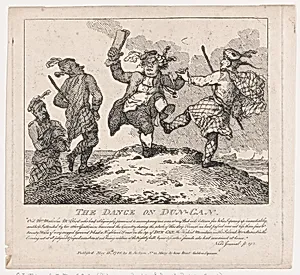
The Dance on Dun-Can (Picturesque Beauties of Boswell, Part the Second)
Medium
Etching
Dimensions
Sheet: 10 9/16 × 11 9/16 in. (26.9 × 29.3 cm) Plate: 10 7/16 × 10 13/16 in. (26.5 × 27.5 cm)
Classification
Prints
Department
Drawings and Prints
Museum
Metropolitan Museum of Art, New York, NY
Credit
Harris Brisbane Dick Fund, 1917
Accession Number
17.3.888-344
Rights
Public Domain
Tags
Art Historical Context
This lively etching, titled *The Dance on Dun-Can*, was published on May 15, 1786, as part of the second installment of *Picturesque Beauties of Boswell*. Created in the medium of etching—a technique prized in the late eighteenth century for its ability to produce affordable, widely circulated images—the print captures a spirited scene of men dancing, reflecting the vibrant cultural encounters described in James Boswell’s popular 1785 travel narrative, *Journal of a Tour to the Hebrides*. The work belongs to a series of satirical and picturesque illustrations inspired by Boswell’s account of his journey through Scotland with Samuel Johnson. Artists such as Samuel Collings and the renowned caricaturist Thomas Rowlandson contributed to these prints, which blended humor with ethnographic detail to bring the Scottish Highlands to a London audience. Elizabeth Jackson’s role as publisher further highlights the collaborative nature of print production during this period. Beyond its visual charm, the etching offers a window into Georgian-era fascination with travel, national identity, and social customs. Its modest dimensions and crisp line work made it an accessible souvenir for viewers eager to imagine the lively traditions of the Hebrides, preserving both the energy of the dance and the era’s curiosity about distant cultures.
About the Artist
Elizabeth Jackson|Samuel Collings|Thomas Rowlandson|Malcolm D. McLeod|James Boswell (British|British) · 1785 |1757 –1787 |1827
British, active 1785–87|British, London 1757–1827 London