
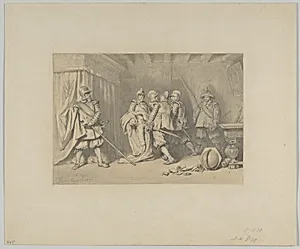
The Dead Wallenstein Being Carried Away by Soldiers
Medium
Graphite, brown wash (?)
Dimensions
Sheet: 9 1/16 × 10 15/16 in. (23 × 27.8 cm)
Classification
Drawings
Department
Drawings and Prints
Museum
Metropolitan Museum of Art, New York, NY
Credit
Purchase, Daniel Ergmann Gift, 2014
Accession Number
2014.110
Rights
Public Domain
Tags
About this artwork
[Research in progress for The Dead Wallenstein Being Carried Away by Soldiers by Karl Theodor von Piloty, 1871]
Art Historical Context
In the dimly lit corridors of history, Karl Theodor von Piloty captures a pivotal moment from the Thirty Years' War his 1871 drawing *The Dead Wallenstein Beingried Away by Soldiers*. von Wallenstein, the ambitious Bohemian general whose military genius and political intrigue made him a central figure in the conflict, met a dramatic end in 1634 assassins—acting on Emperor Ferdinand II's orders—stabbed him to death in Eger (now Cheb, Czech Republic). Piloty's graphite and brown wash sketch vividly depicts soldiers bearing the lifeless commander, swords at their sides, evoking the raw brutality of betrayal and war. A leading figure in 19th-century German history painting, Piloty (1826–1886) was renowned for his theatrical, realistic style, blending meticulous detail with emotional intensity as director of the Munich Academy. This preparatory drawing, with its subtle brown wash adding depth and shadow to the figures, highlights his mastery of monochrome techniques—ideal for studies leading to grand oil paintings. The compact sheet (9 1/16 × 10 15/16 in.) showcases dynamic composition, the soldiers' strained poses conveying urgency and somber finality. Acquired by the Metropolitan Museum of Art in 2014 through the Daniel Ergmann Gift, this work offers a window into Piloty's process and the enduring fascination with Wallenstein's tragic fall, immortalized in literature by Schiller and others. It reminds us how art revives the echoes of history's turning points.