
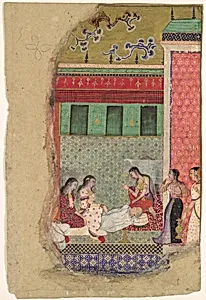
"The Death of King Dasharatha, the Father of Rama", Folio from a Ramayana
Unknown Artist
ca. 1605
Medium
Opaque watercolor and gold on paper
Dimensions
Painting: H. 10 1/2 in. (26.7 cm) W. 5 13/16 in. (14.8 cm) Page: H. 10 7/8 in. (27.6 cm) W. 7 1/2 in. (19.1 cm) Mat: H. 19 1/4 in. (48.9 cm) W. 14 1/4 in. (36.2 cm)
Classification
Codices
Department
Islamic Art
Museum
Metropolitan Museum of Art, New York, NY
Credit
Cynthia Hazen Polsky and Leon B. Polsky Fund, 2002
Accession Number
2002.506
Rights
Public Domain
Tags
Art Historical Context
This exquisite folio from around 1605 captures a poignant moment from the ancient Indian epic Ramayana: the death of King Dasharatha, Rama’s father, who succumbs to grief after exiling his beloved son. Created with opaque watercolor and gold on paper, the painting belongs to a codex—a lavishly manuscript—where text and image worked together to bring sacred stories to life for royal or courtly audiences. Housed in the Metropolitan Museum’s Department of Islamic Art, the work reflects the rich cultural exchanges of early seventeenth-century South Asia. At this time, Mughal patrons often commissioned illustrated versions of Hindu epics alongside Persian and Islamic texts, blending artistic traditions from across the region. The delicate use of gold highlights the emotional weight of the scene, while the compact vertical format was ideal for intimate viewing within a bound manuscript. As part of a larger narrative cycle, this folio would have guided viewers through the epic’s moral and emotional lessons. Its presence in an Islamic art collection underscores how stories like the Ramayana transcended religious boundaries, becoming shared treasures of visual storytelling and devotion.