
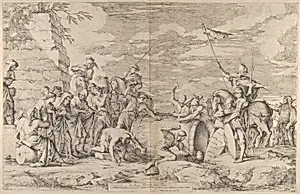
The death of Marcus Atilius Regulus, showng being nailed into a tub by the Carthaginians
ca. 1661–62
Medium
Etching
Dimensions
sheet: 22 5/16 x 30 1/2 in. (56.6 x 77.4 cm) plate: 18 3/16 x 28 1/2 in. (46.2 x 72.4 cm)
Classification
Prints
Department
Drawings and Prints
Museum
Metropolitan Museum of Art, New York, NY
Credit
Bequest of Phyllis Massar, 2011
Accession Number
2012.136.920
Rights
Public Domain
Tags
Art Historical Context
Salvator Rosa, a fiery Italian Baroque artist renowned for his dramatic history paintings, landscapes, and etchings, captured a gruesome moment from ancient history in this powerful print from around 1661–62. Titled *The Death of Marcus Atilius Regulus the etching depicts the Roman general's legendary torture by Carthaginian captors during the First Punic War (264–241 BCE). Regulus, a hero of Rome's struggle against Carthage, was sent as an envoy to negotiate peace but urged his city to fight on. Enraged, the Carthaginians—shown here nailing him into a spiked barrel—are said to have rolled him to his doom, a tale immortalized by Roman historians like Horace to exalt stoic virtue. As an etching, this work highlights Rosa's virtuosic command of the medium, using fine, expressive lines to convey chaos, anguish, and brutality amid soldiers, horses, men, and women. Measuring nearly 18 by 28 inches on the plate, its large scale amplifies the theatrical intensity typical of Rosa's "baroque sublime," blending historical gravitas with emotional fervor. Prints like this made grand narratives accessible beyond elite patrons, influencing later Romantic artists drawn to heroic tragedy. Today, housed in the Metropolitan Museum of Art, it reminds visitors of art's power to preserve perilous legends, inviting reflection on courage amid savagery.
About the Artist
Salvator Rosa · 1615–1673
Salvator Rosa was born in 1615 in Arenella, on the outskirts of Naples, into a world of artistic ambition and turbulent talent. His early training came through his maternal uncle, the painter Paolo Greco, and his brother-in-law Francesco Fracanzano, himself a pupil of the great Spanish-born Neapolitan master Jusepe de Ribera. Rosa showed a fierce independence from the start, resisting his father's...