
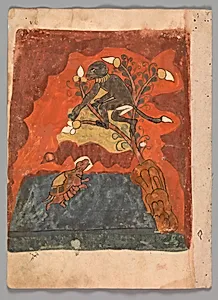
"The Deposed Monkey King Drops Figs for the Tortoise and the Two Become Friends", Folio from a Kalila wa Dimna
Unknown Artist
second quarter 16th century
Medium
Ink and opaque watercolor on paper
Dimensions
Overall: H. 12 1/2 in. (31.8 cm) W. 8 7/8 in. (22.6 cm) Average text size: H. 8 5/8 in. (21.9 cm) W. 4 7/8 in. (12.4 cm)
Classification
Codices
Department
Islamic Art
Museum
Metropolitan Museum of Art, New York, NY
Credit
The Alice and Nasli Heeramaneck Collection, Gift of Alice Heeramaneck, 1981
Accession Number
1981.373.75
Rights
Public Domain
Tags
Art Historical Context
This enchanting folio from a *Kalila wa Dimna* manuscript captures a pivotal moment in one of the ancient fables that inspired it: the deposed Monkey King humbly drops figs for a tortoise, forging an unlikely friendship. Part of a renowned collection of animal parables originating from the Indian *Panchatantra* and adapted into Persian during the Islamic Golden Age, these stories use anthropomorphic creatures to impart moral lessons on wisdom, loyalty, and humility. Created by an unknown artist in the quarter of the 16th century—likely in Safavid Persia—this page exemplifies the golden era of Persian miniature painting within Islamic art traditions. Rendered in ink and opaque watercolor on paper, the artwork showcases the meticulous techniques of the period: delicate black ink outlines define expressive figures, while vibrant gouache-like colors bring the lush landscape and lively animals to life. Monkeys and turtles, tagged as central motifs, interact with human-like emotions against a stylized natural backdrop, blending narrative text with illustration in a codex format typical of courtly manuscripts. Housed in the Metropolitan Museum of Art's Islamic Art Department (gift of Alice Heeramaneck, 1981), this folio highlights the cultural crossroads of Persian, Indian, and Arab influences, serving as both entertainment and ethical guide for elite audiences. It invites us to reflect on timeless themes of reconciliation amid adversity.