
The Descent of Christ to Limbo (recto); Coats of Arms of Florentine and Sienese Families (verso)
ca. 1536
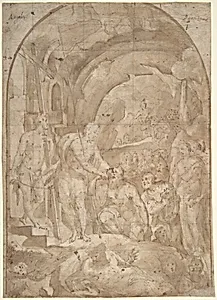
Medium
Pen and brown ink, brush and brown wash, over traces of leadpoint or black chalk; squared in leadpoint (recto); pen and brown ink (verso)
Dimensions
9 × 6 3/8 in. (22.9 × 16.2 cm)
Classification
Drawings
Department
Drawings and Prints
Museum
Metropolitan Museum of Art, New York, NY
Credit
Purchase, Gifts from Mrs. Gardner Cassatt, Mrs. Francis Ormond, Bessie Potter Vonnoh, William Benton, Donald Silve, William M. Ivins Jr., and Mrs. Harry Payne Whitney, and other gifts, bequests, and funds, by exchange, 1997
Accession Number
1997.501a, b
Rights
Public Domain
Tags
Art Historical Context
This double-sided drawing by Domenico Beccafumi, created around 1536, captures a pivotal moment from Christian tradition on its recto: Christ’s descent into Limbo to redeem the righteous souls who died before his resurrection. The compact sheet, measuring just 9 by 6⅜ inches, reveals the artist’s working process through its visible underdrawing, fluid brown washes, and careful squaring in leadpoint—marks that indicate the composition was likely transferred to a larger painting or fresco. On the verso, Beccafumi sketched the coats of arms of prominent Florentine and Sienese families, offering a fascinating glimpse into the civic and heraldic interests of sixteenth-century Tuscany. The juxtaposition of a sacred narrative with these secular emblems reflects the close ties between religious art and the ruling elites of Siena and Florence during the Renaissance. Beccafumi, a leading figure of Sienese Mannerism, used the expressive possibilities of pen and wash to heighten drama and movement, qualities that made his drawings prized by collectors. Today the sheet resides in the Metropolitan Museum’s collection of Drawings and Prints, where it continues to illuminate both the artist’s inventive technique and the cultural world he inhabited.
About the Artist
Domenico Beccafumi · 1484–1551
Italian artist. Comment on works: History