
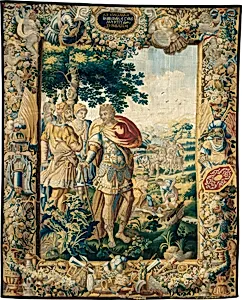
The Diversion of the Euphrates from The Story of Cyrus
c. 1670
Medium
Wool and silk, slit and single interlocking tapestry weave Warp: Count: 8 warps per cm; wool: S-ply of three Z-spun elements; diameters: 0.6–1.0 mm Weft: Count: varies from 19 to 44 wefts per cm; wool: S-ply of two Z-spun elements; diameters: 0.3–1.5 mm; silk: pairs of S-ply of two Z-twisted elements; diameters: 0.15–0.5 mm
Dimensions
325.4 × 404.8 cm (128 1/8 × 159 3/8 in.)
Classification
weaving - tapestry
Department
Textiles
Museum
Art Institute of Chicago
Accession Number
27849
Rights
Public Domain
About this artwork
The Latin inscriptions in the center of the upper border of this and the neighboring tapestry make clear that they illustrate the story of Cyrus the Great, ruler of the Medes and the Persians. Here he oversees the laborious work of diverting the Euphrates River, a tactic that would permit his troops to approach the city of Babylon and conquer it. These tapestries were woven from cartoons that adapted designs by the 16th-century court artist Michiel Coxie. Their rich borders, filled with garlands...
Art Historical Context
Behold *The Diversion of thehrates from The Story of Cyrus*, a magnificent tapestry woven in the workshop of Flemish artist Gillis Ydens 1670. This monumental piece (325.4 × 404.8 cm) captures a dramatic episode from the legend of Cyrus the Great, ancient Persian conqueror who, according to Herodotus, diverted the Euphrates to enable his army's stealthy entry into Babylon in 539 BCE. Produced during the Baroque era, it reflects the era's fascination with grand historical narratives, blending vivid storytelling with opulent craftsmanship. Crafted in wool and silk using slit and single interlocking tapestry weaves, the artwork showcases exceptional technical virtuosity. The warp consists of 8 wool warps per cm, while the weft varies from 19 to 44 per cm, incorporating fine silk for luminous highlights. These techniques allowed weavers to create seamless, richly colored scenes without painting directly on the fabric, a hallmark of 17th-century Flemish tapestry production. Such large-scale works were prized luxury items for European palaces and churches, symbolizing wealth and cultural sophistication. Housed in the Art Institute of Chicago's Textiles Department, this tapestry invites visitors to marvel at its scale and intricate details, evoking the engineering triumphs of antiquity through the lens of early modern artistry. A testament to collaborative workshop traditions, it bridges ancient history with the refined aesthetics of the Dutch Golden Age.